I’m exploring
The overall plan, then the article, the basic unit of the course: enough to know quickly whether this course is for you.
Start →Reader’s guide · 8 films
Five volumes, three levels, exercises, expeditions, companions: this course has an architecture. These films explain it, so you can choose your starting point and work through each article without getting lost.
Free, no account. Every film comes in French and English, with subtitles.
The eight episodes
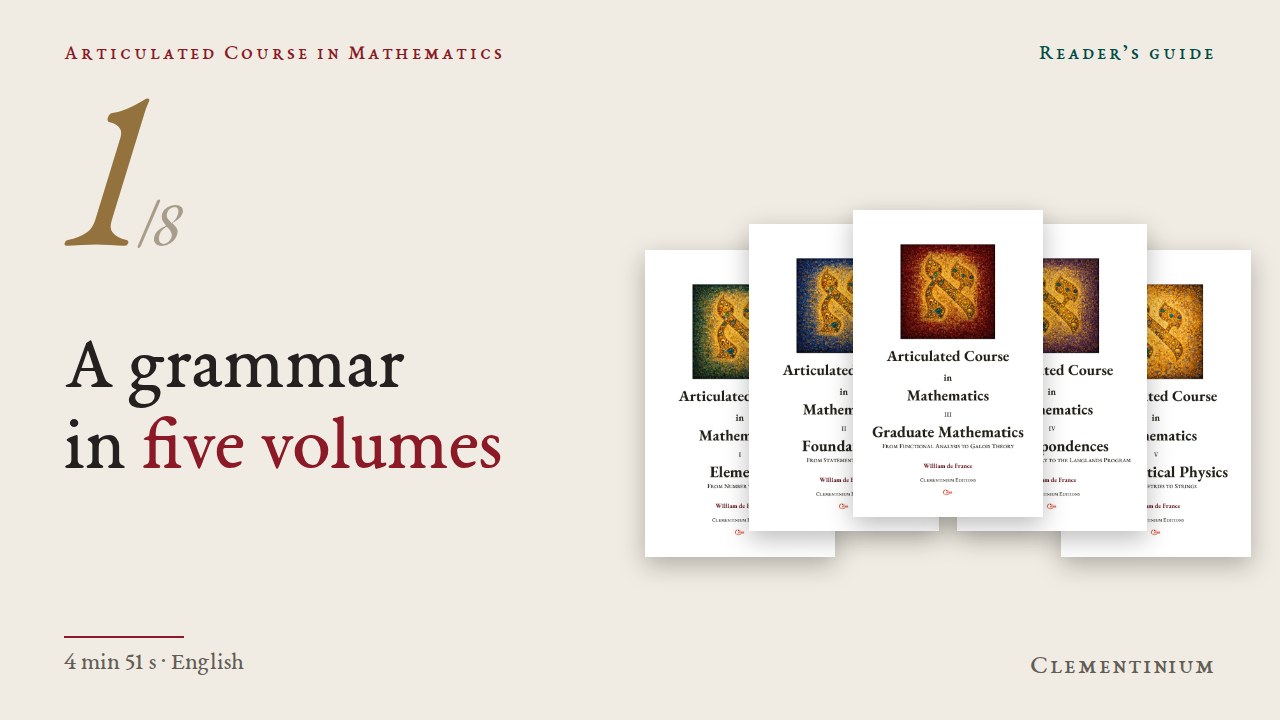 4 min 51 sEpisode 1 / 8A grammar in five volumesFive volumes, three levels: where to enter, depending on what you know.
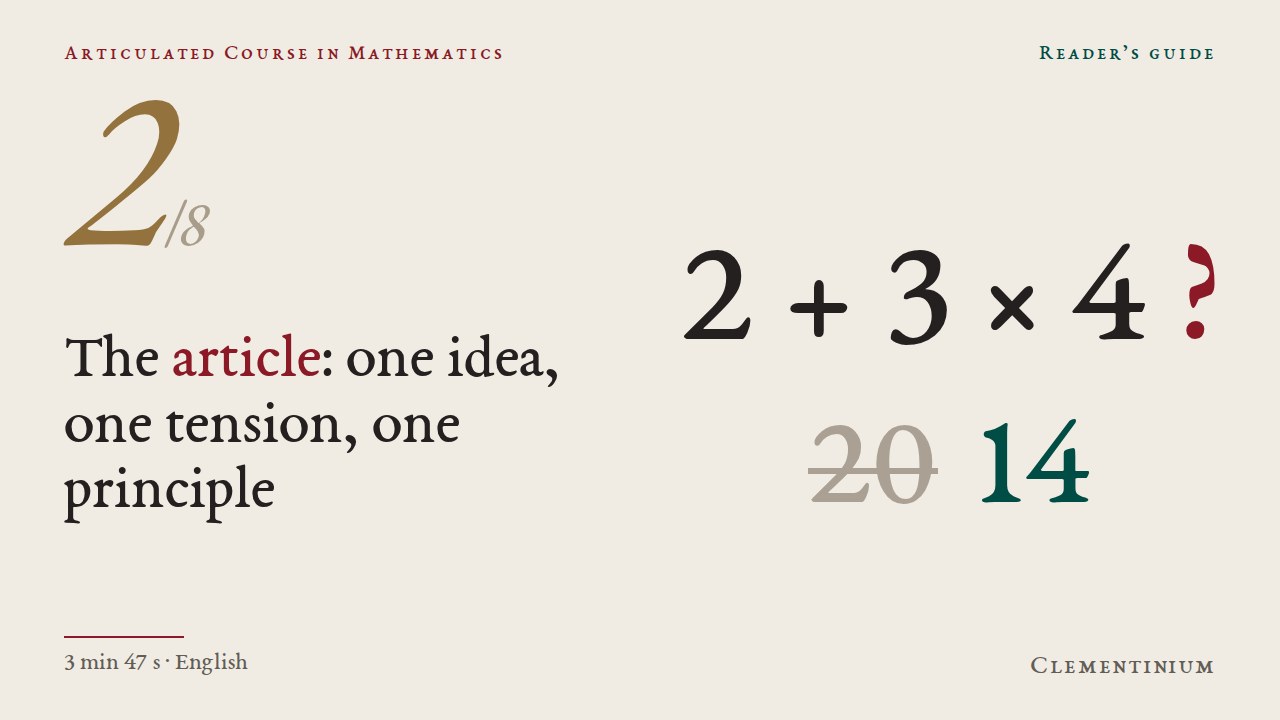 3 min 47 sEpisode 2 / 8The article: one idea, one tension, one principleThe first article opens with a question: what is 2 + 3 × 4?
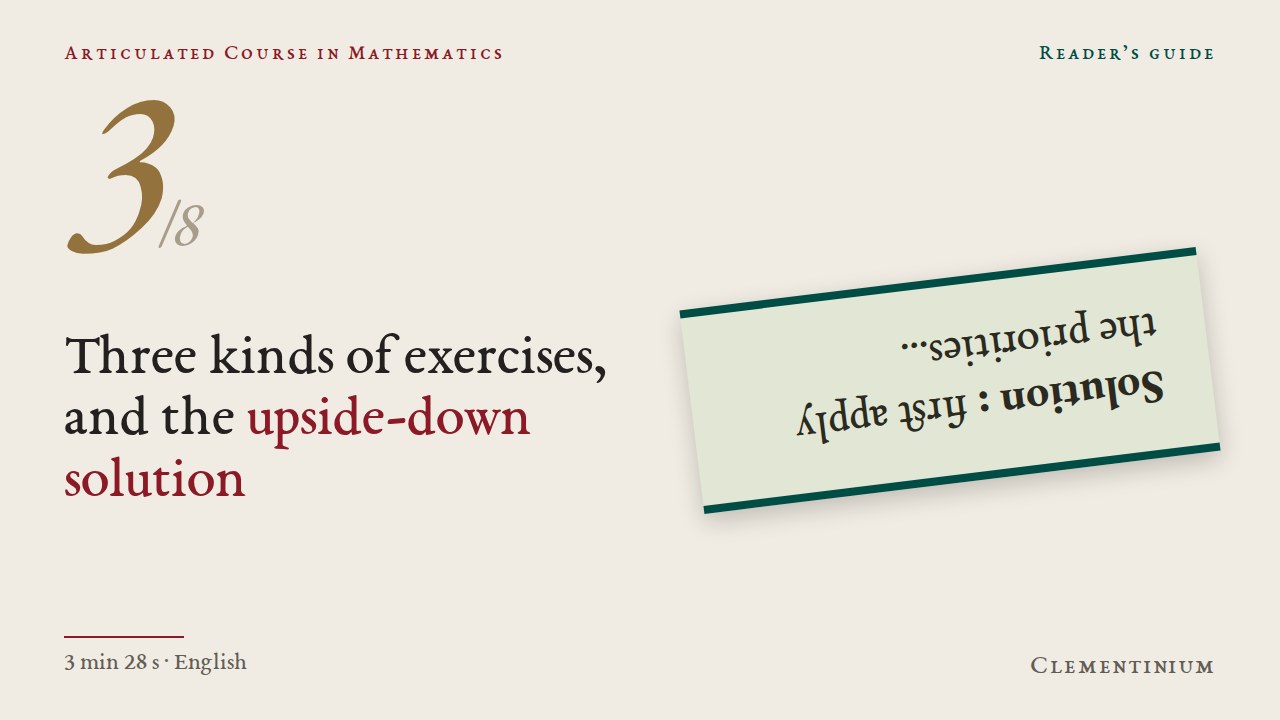 3 min 28 sEpisode 3 / 8Three kinds of exercises, and the upside-down solutionGraded exercises, and solutions printed upside down.
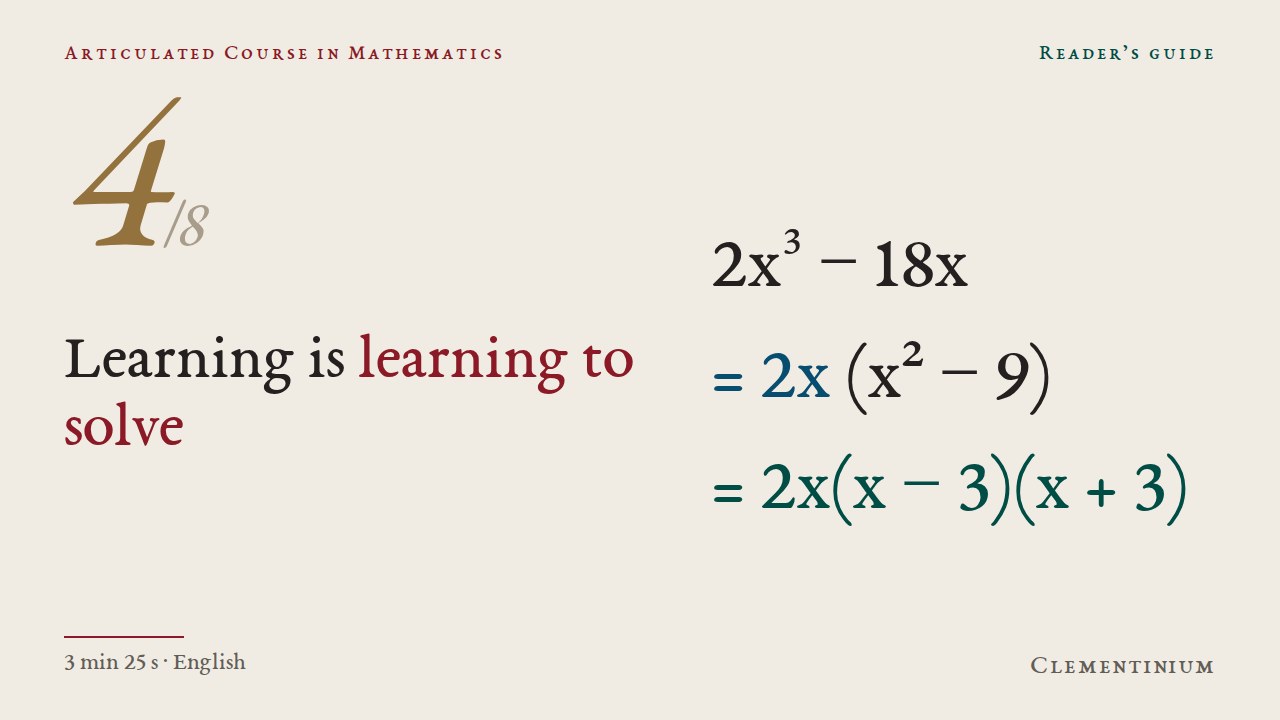 3 min 25 sEpisode 4 / 8Learning is learning to solveKnowing a theorem is not knowing how to solve a problem.
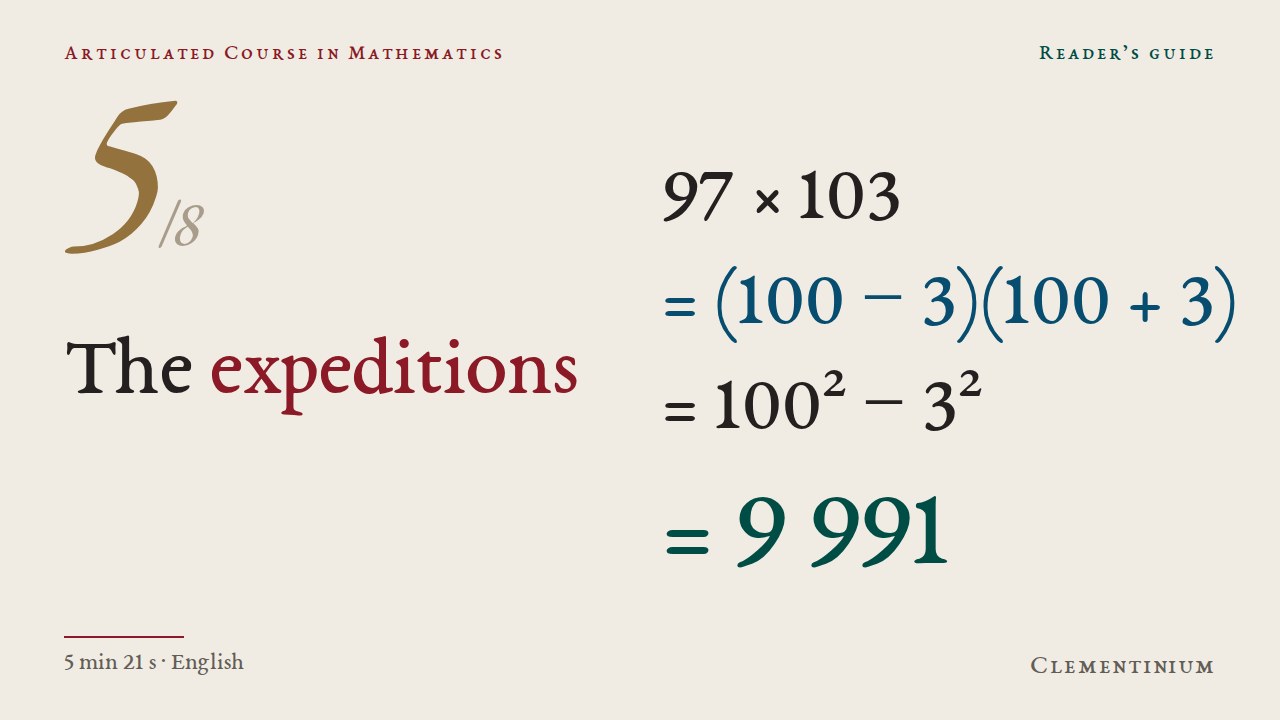 5 min 21 sEpisode 5 / 8The expeditions97 × 103 in your head, Pascal’s triangle, (1.01)ⁿ: three expeditions.
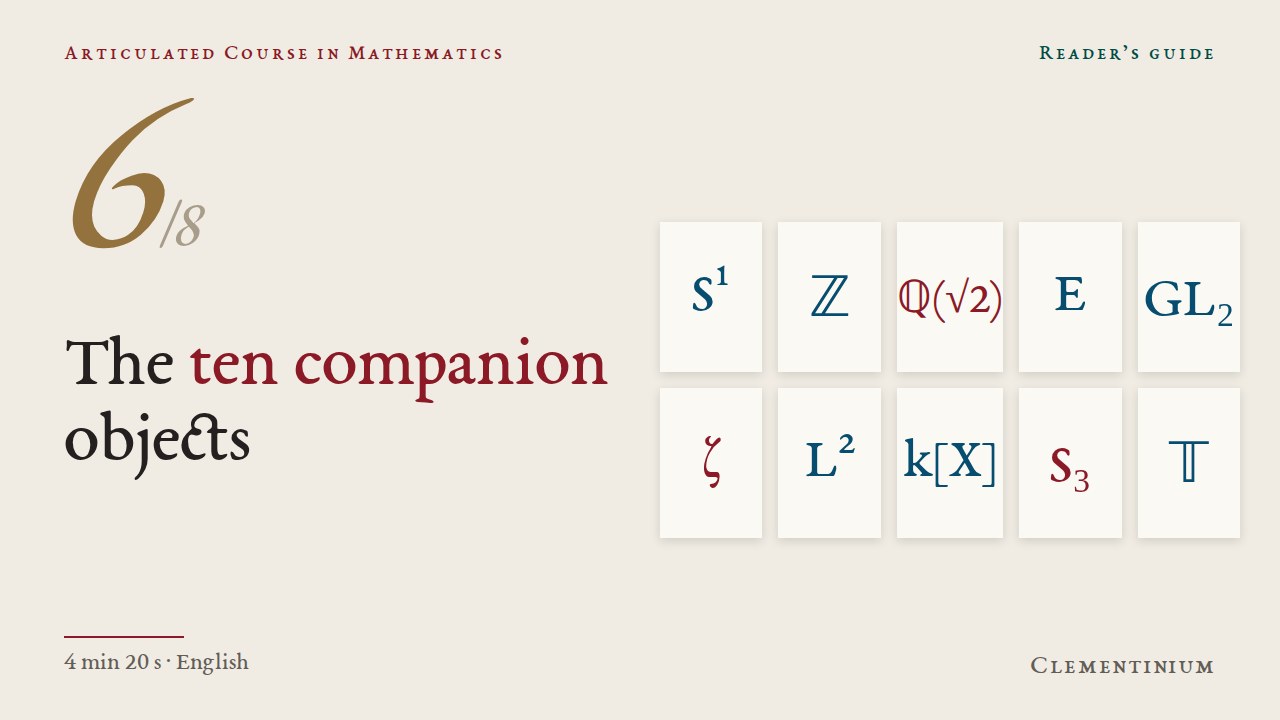 4 min 20 sEpisode 6 / 8The ten companion objectsTen objects, from the circle to the torus, that return from volume to volume.
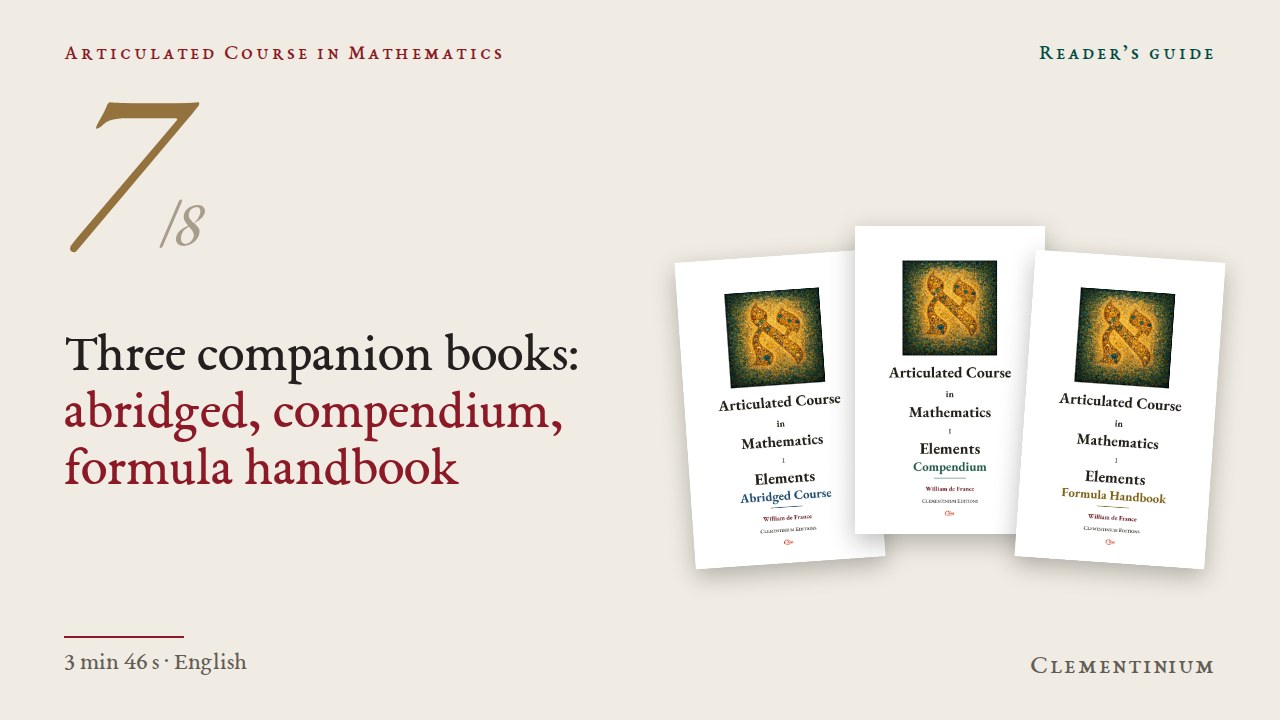 3 min 46 sEpisode 7 / 8Three companion books: abridged course, compendium, formula handbookAbridged course, compendium, formula handbook: three companions, three ways to work.
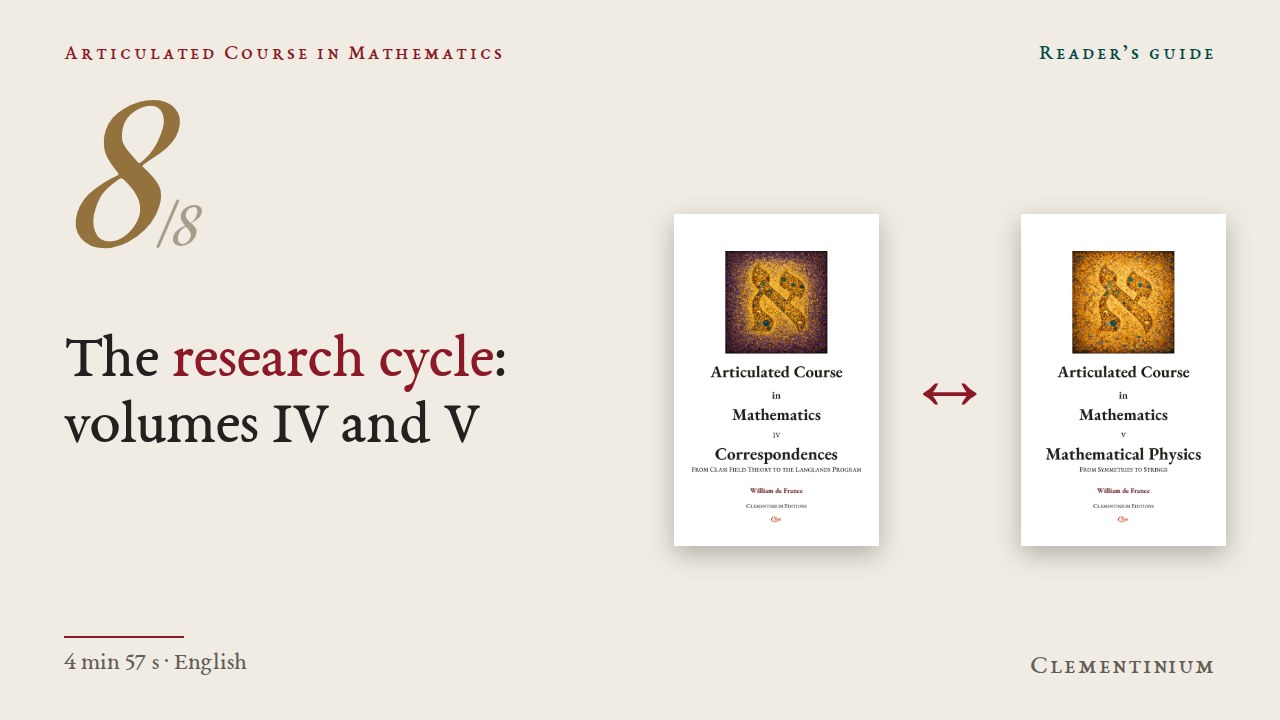 4 min 57 sEpisode 8 / 8The research cycle: Correspondences and Mathematical PhysicsCorrespondences and Mathematical Physics: what the research cycle expects.
Depending on what you need
The overall plan, then the article, the basic unit of the course: enough to know quickly whether this course is for you.
Start →The three kinds of exercises, the method that teaches problem solving, and the expeditions that go further than expected.
Start →Ten objects that run through the collection, and three companions per volume: the abridged course, the compendium and the formula handbook.
Start →Correspondences and Mathematical Physics: what the research level expects, and how the two volumes answer each other.
Start →Then, a real page
The opening pages, the table of contents and the complete first chapter, no account needed.
From Number to Form
From Statement to Space
From Functional Analysis to Galois Theory
From Class Field Theory to the Langlands Program
From Symmetries to Strings