ClementiniumClementinium Editions

Where should I begin?

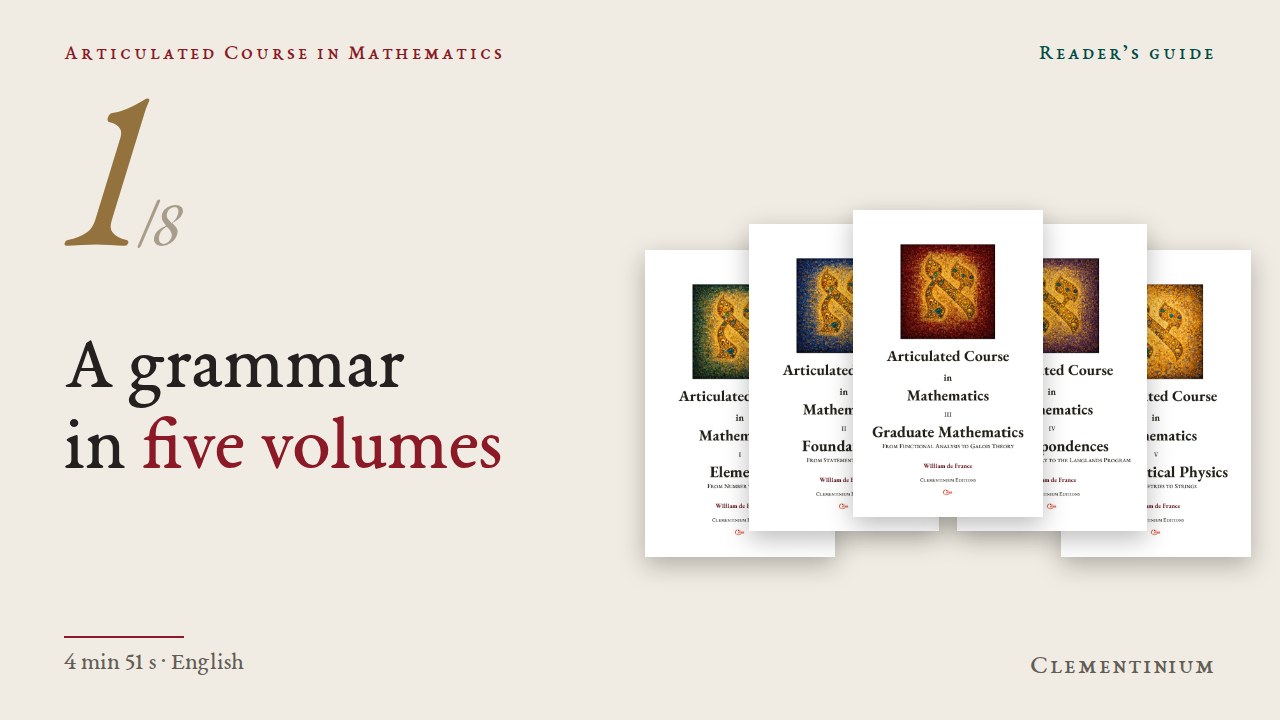
The Mathematics Course spans five volumes and 6,200 pages, from high school to research. You do not enter it at random: this page gives the door according to where you come from, and the path according to where you are going.

This guide also exists as a PDF booklet, typeset like the volumes — free to keep and to share. Download the booklet ↓

You are reading out of curiosity, with no plan to work through a course

Start with the essay The Apocalypse According to Galois: the story, with no prerequisites, of what the course proves. The Reading room then lets you leaf through an excerpt of all five volumes, online, without downloading anything.

You are discovering mathematics beyond high school

Start with Volume I, Elements — it begins with number and builds everything else. The essay The Apocalypse According to Galois can come first: it is the story, with no prerequisites, of what the course proves.

You studied once, but high school is far behind

Enter through Volume II: its first part, "Learning to Read Mathematics", re-teaches in six chapters how to read a statement, a definition, a proof. Keep Volume I as a reference for any missing foundations.

You are a mathematics undergraduate

Volume II, Undergraduate, is your working volume — the longest in the collection, the one where proof itself becomes the object of study.

You are preparing a master's degree or the agrégation

Volume III, Graduate, runs from functional analysis to Galois theory and algebraic geometry. The chapters of Volume II reread as refreshers.

You want to understand the Langlands program

Volume IV, Correspondences, is the destination; it assumes from Volume III Galois theory, some commutative algebra, and complex analysis.

You come from physics

Volume V, Mathematical Physics, reads after the functional analysis and Lie groups of Volume III; it is independent of Volume IV.

I. Elements — From Number to FormHigh school

Assumes : middle-school mathematics · Builds : computation, proof, geometry, complex numbers, functions, probability — the chain ℕ ⊂ ℤ ⊂ ℚ ⊂ ℝ ⊂ ℂ

II. Undergraduate — From Statement to SpaceUndergraduate

Assumes : Volume I, or solid high-school mathematics · Builds : how to read statements, real analysis, linear algebra, groups, measure theory, first steps into complex and functional analysis

III. Graduate — From Functional Analysis to Galois TheoryMaster, agrégation

Assumes : Volume II · Builds : functional analysis, distributions, Galois theory, algebraic geometry, manifolds, Lie groups — the structures

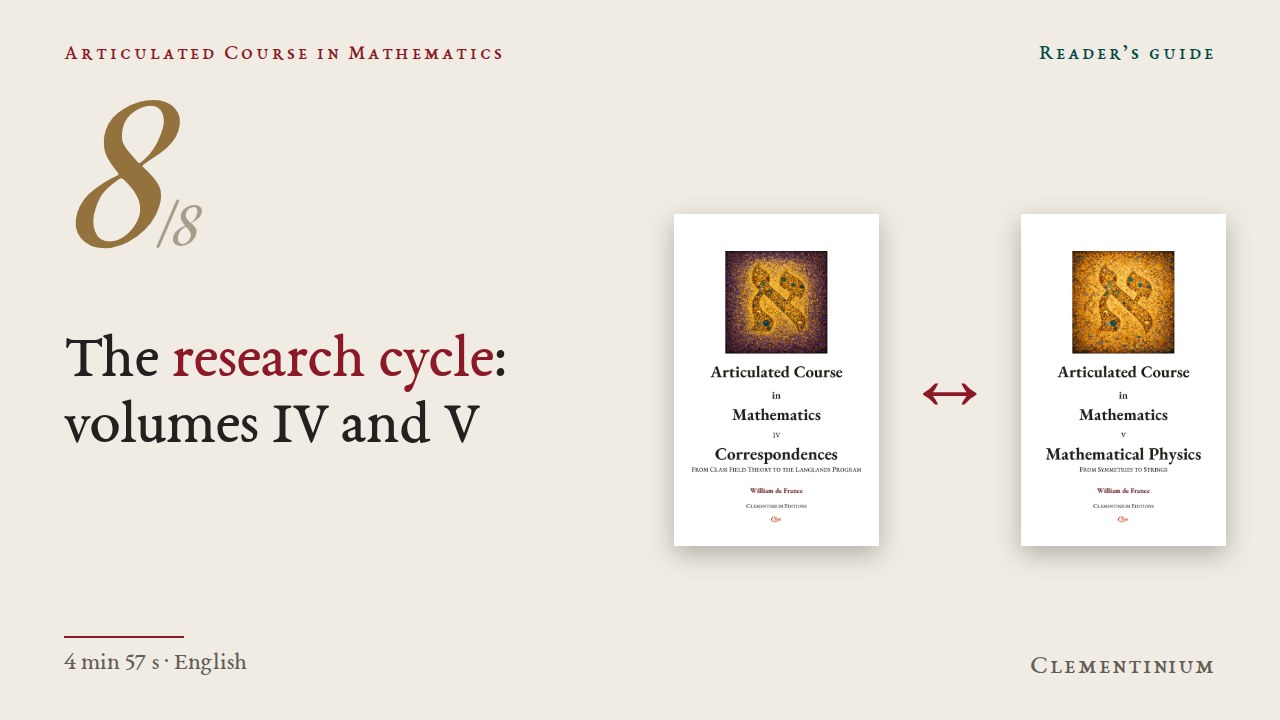
IV. Correspondences — From Class Field Theory to the Langlands ProgramDoctoral, research

Assumes : from Volume III: Galois theory, commutative algebra, complex analysis · Builds : number fields, class field theory, modular forms, Galois representations, up to the Langlands program

V. Mathematical Physics — From Symmetries to StringsDoctoral, research

Assumes : from Volume III: functional analysis, manifolds, Lie groups — independent of Volume IV · Builds : mechanics, quantum theory, gauge theories, fields, relativity, strings

Volumes I through III follow one another. Beyond that the paths part: Volume IV (Correspondences) and Volume V (Mathematical Physics) both assume Volume III, but are independent of each other.

No one is required to read everything. Each track crosses the volumes keeping only the parts that serve it.

The algebra and arithmetic track

I (arithmetic, quadratics, complex numbers) → II (polynomials and groups, linear algebra, arithmetic) → III (general algebra, Galois theory, commutative algebra, algebraic geometry) → all of IV.

The analysis track

I (functions, sequences, the integral) → II (real analysis, series, measure and integration, complex analysis) → III (functional analysis, distributions and Fourier, differential equations, dynamical systems) → V for analysis put to work.

The mathematical physics track

I → II (linear algebra, multivariable calculus, probability) → III (functional analysis, manifolds, Lie groups, Riemannian geometry) → V (from symmetries to strings).

Twelve weeks

One volume, thoroughly: all of Volume I (655 pages, about 55 a week), or a chosen part of a later volume.

Twenty-four weeks

A full track to graduate level: your track's chapters across Volumes I–III, about 60 pages a week.

One year

The whole course, 6,200 pages — a serious commitment, about 120 pages a week. Realistic for a sabbatical year or a reading pair.

Every volume can be browsed freely — in the Reading room, online, or through the PDF sample on its page. Judge for yourself before choosing your door.

The house letter, quarterly, announces new titles and corrected editions. Receive La Lettre