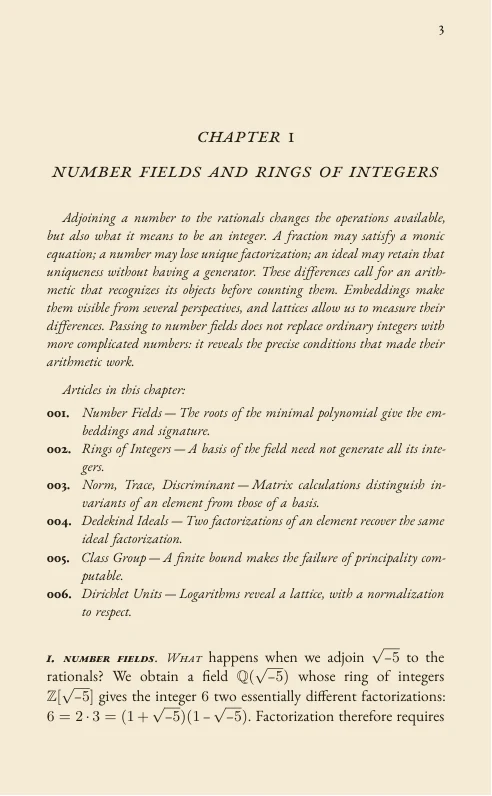
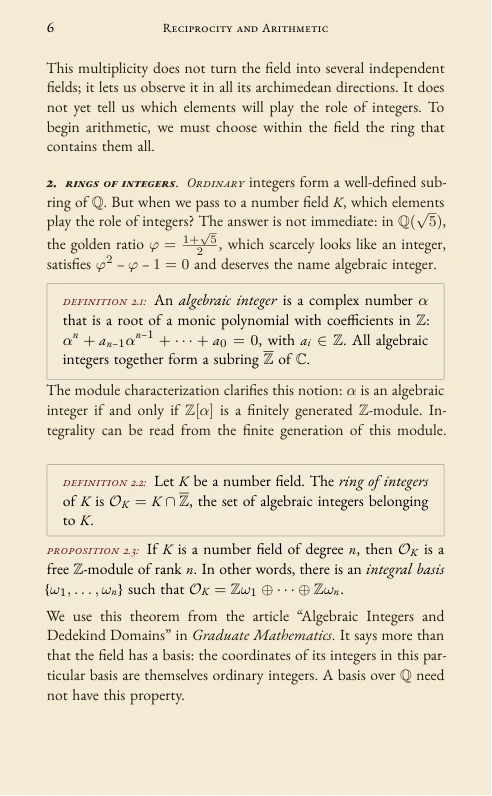
The route through the 2024 proof
An entire part follows geometric Langlands: the theorem and its scope, construction of the functor, reduction steps, and multiplicity one.
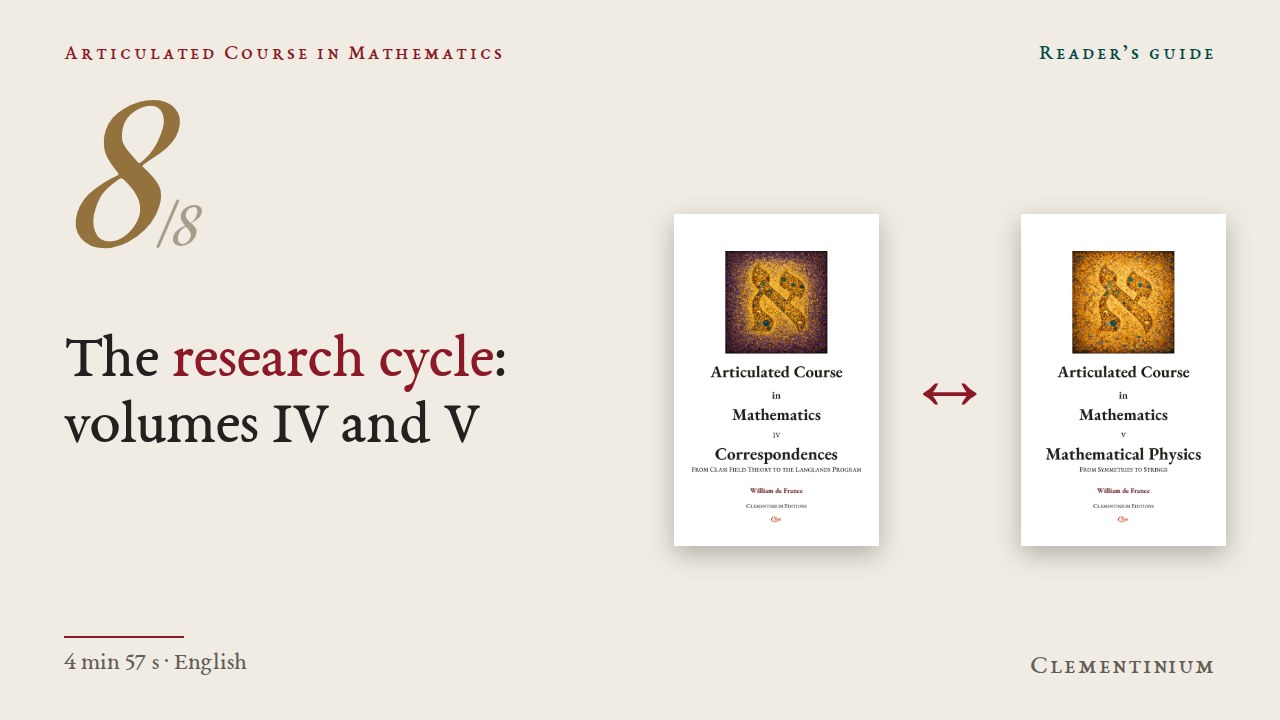
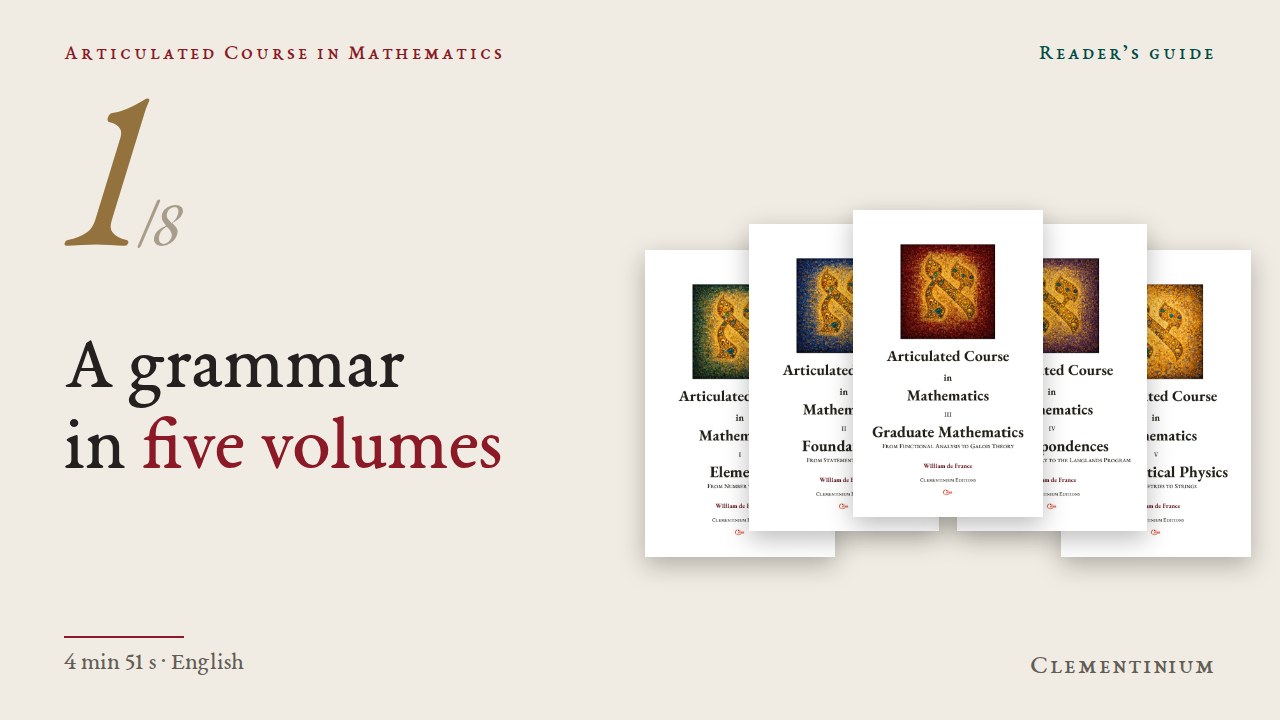
Articulated Course in Mathematics · IV
From Class Field Theory to the Langlands Program
Why do arithmetic and analysis speak the same language? From number fields to the Langlands program, follow the correspondences that organize contemporary research.
Digital PDFs. No printed book is shipped. One language per purchase.
Your starting point
Algebra, analysis, and geometry from Volume III, with reminders at key transitions.
The text distinguishes established results, constructions under stated assumptions, and research perspectives. Reminders and cross-references support the reading.
An entire part follows geometric Langlands: the theorem and its scope, construction of the functor, reduction steps, and multiplicity one.
Local fields, automorphic forms, schemes, sheaves, and categories progressively build the required language.
Discover this volume
Volume IV: from class field theory to the Langlands program · 8 min 14 s
y² + y = x³ − x²: counting its solutions modulo 2, 3, 5 and 7 gives 5, 5, 5, 10. Nothing in these numbers looks like a law. And yet they turn up, exactly, in a function. An overview of Volume IV of the Articulated Course in Mathematics: who it is for, the map (eight parts, thirty-seven chapters, two hundred and thirty-eight articles), the four ideas that hold it together, counts on a curve set against a modular series, how to work with the volume, and what makes the difference.
In the book: foreword and bridge “From graduate to doctoral” of Volume IV; articles 073, 075, 087, 089, 092, 185 and 190; end of chapter 13.
Read the free excerpt ↓Here is an equation. y squared plus y equals x cubed minus x squared. Let’s count its solutions modulo two, three, five and seven, adding a point at infinity: five, five, five, ten. Nothing in these numbers looks like a law. And yet these counts turn up, one by one, in a function that never mentions equations. This volume is about why. Articulated Course in Mathematics. Volume four: from class field theory to the Langlands program.
The fourth volume makes a promise. The same equation can be read through its solutions, through its symmetries, or through the functions that record their traces. The Langlands program asks how to pass from one reading to another without losing the operations that give them meaning. This volume follows that question from number fields to the geometric correspondence, and through its 2024 proof. It is for readers who want to understand how the domains connect, and then return to the sources for the complete constructions and proofs. It assumes the background of volume three: Galois theory, functional analysis and differential geometry. And it names the real change. Until now, each branch had its own language: limits, groups, manifolds. This volume tells of a discovery: these languages are dialects of a common grammar. Together with volume five, it opens the research level.
Here is the map. Eight parts. Thirty-seven chapters. Two hundred and thirty-eight articles, six hundred and forty-eight pages. Arithmetic first: number fields, p-adic numbers, adeles, reciprocity. Forms: modular forms, L-functions, dual groups, automorphic representations. Curves: from arithmetic geometry to modularity, Shimura varieties and motives. The geometric side: differential modules, bundles on curves, derived categories, then the theorem and a path through its proof. And a final chapter that opens toward physics, through charges, lines and branes.
Four ideas hold the whole together. The first: look locally to understand globally. Reciprocity says how the readings of a number, modulo each prime, answer one another, and volume three already gave a first case. The second: turning to symmetries. In volume three, Galois read in an equation the group of its symmetries. Here we study the representations of that group, and those of the group G L two. Each group then receives a dual group. The third: L-functions, which record the traces. The Riemann zeta function, met in volume three, is the first example. Each L-function is a dictionary. The fourth: changing objects. The geometric theorem then identifies two entire categories. But the book keeps its measure: the unramified de Rham geometric theorem does not resolve the whole arithmetic program. And beneath all four runs a thread: familiar objects return with new functions. The square root of two, seen from volume one, and the field it generates. The curve y squared equals x cubed minus x, and the group G L two, announced in volume two.
Back to our equation. To learn how to count, let’s first take a simpler curve, the one the collection has announced since volume one: y squared equals x cubed minus x. Modulo five, there are only five possible values of x: zero, one, two, three, four. For each one, we look for the values of y that work. We find one, one, two, two, one. Seven points, plus the point at infinity: eight. We keep the gap from five plus one: five plus one minus eight, that is, minus two. Modulo three, we find four points: the gap is zero. It is zero whenever the prime has the form four k plus three: a regularity the book proves, and that shows in the counts. Back to the equation we began with. Its gaps, for two, three, five and seven, are minus two, minus one, one, and minus two. Now write down, still without counting anything, a product of eta functions, and expand it as a series. We get q, minus two q squared, minus q cubed, plus two q to the fourth, plus q to the fifth, plus two q to the sixth, minus two q to the seventh. The coefficients of index two, three, five and seven are exactly the gaps we found. That this series is a modular form, the book admits. Four coefficients that agree prove nothing. What guarantees all of them, for this curve, is modularity. And that every curve over the rationals turns up this way is the modularity theorem, of which Fermat’s last theorem is a consequence. Matching names does not build a correspondence. The operations have to follow, with their compatibilities, and their proofs.
How do you work with this volume? The article remains the unit of reading: a question, a construction, a worked example, and its interpretation. Each chapter closes with further reading, which leads to the sources, and with research questions: extending a calculation, testing a distinction, situating a conjecture. They are not all open problems: each gives the reader an operation to pursue. Chapter thirteen, on elliptic curves, closes on the Birch and Swinnerton-Dyer conjecture: the rank of the curve should be the order of vanishing of its L-function at one. At one article a day, the volume takes about eight months.
What makes the difference comes down to a few rules. One article, one question. Hypotheses and normalizations stay in the statements. A difficult result is flagged as admitted when the article explains its role. And the volume exists in French and in English. “The grammar through which reality composes itself is unfinished. What we know of it, what we glimpse, and what remains to be discovered are the subject of this volume.”
To remember. Volume four: from class field theory to the Langlands program. Eight parts, two hundred and thirty-eight articles, a path through the 2024 proof. And counts on a curve that turn up, exactly, in a function. Volume four opens for free: the first pages, the table of contents, and the whole of chapter one. The link is in the description.
Work with the course
Articles, exercises, methods and companion books: films to support your reading. No account needed, in French and English.
Inside the volume
Your digital edition
The files below come together in a single purchase, in the selected language.
After payment: personal download links and access through My library.
Understand the editions →Open the book
The opening pages, table of contents, and complete first chapter. Page numbers are those of the full book. 37 p. · PDF