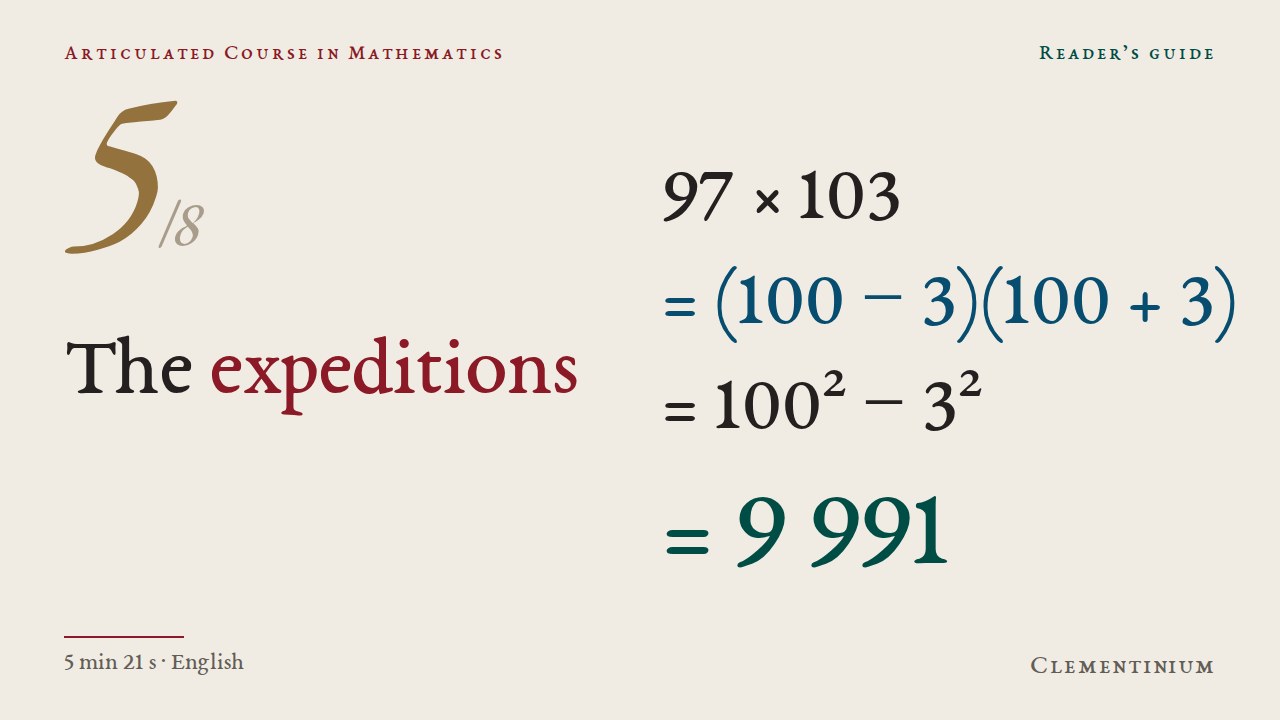
From calculation to reasoning
Numbers, expressions, equations: the first tools become a language for stating and proving.
Articulated Course in Mathematics · I
From Number to Form
Calculate with confidence. Draw a figure. Understand what makes a proof work. The first volume builds the skills and language needed for everything that follows.
Digital PDFs. No printed book is shipped. One language per purchase.
Your starting point
School algebra and geometry; curiosity and an interest in reasoning.
The course develops the reasoning. Exercises and methods put it into practice; expeditions invite you to explore an idea further.
Numbers, expressions, equations: the first tools become a language for stating and proving.
Figures, coordinates, and functions connect calculation with geometric intuition.
Discover this volume
Volume I: from number to form · 7 min 54 s
i squared equals minus one: what if it were just a quarter turn? An overview of Volume I of the Articulated Course in Mathematics: who it is for, the map (seven parts, twenty-two chapters, one hundred and sixty articles), the four ideas that hold it together, one moment from the book shown live, how to work with the volume, and what makes the difference.
In the book: foreword to Volume I; articles 017, 081, 082 and 093; exercises from chapters 12 and 13.
Read the free excerpt ↓Here is perhaps the strangest rule in school mathematics. i squared equals minus one. A number whose square is negative. You learn it, you apply it, and you never quite trust it. What if it were just a quarter turn? Articulated Course in Mathematics. Volume one: from number to form.
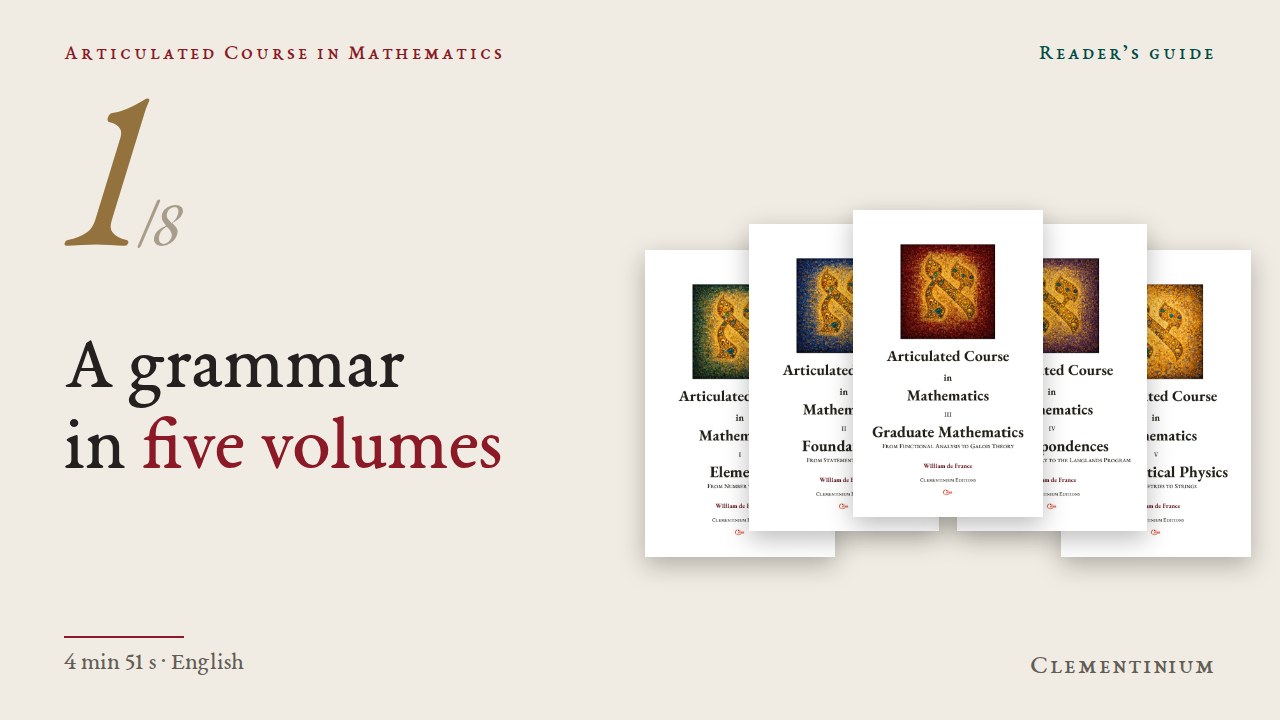
The first volume makes a simple promise. Calculate with confidence. Draw a figure. Understand what makes a proof hold. It is addressed, the foreword says, to anyone entering formal mathematics, perhaps with curiosity, perhaps with apprehension. To anyone rebuilding the foundations, or preparing for university. It assumes nothing beyond elementary arithmetic. It covers the core of secondary-school mathematics, and adds a few glimpses of university mathematics, where they shed light on an idea. It leads to the threshold of university, which is where volume two begins.
Here is the map. Seven parts. Twenty-two chapters. One hundred and sixty articles, some seven hundred pages. First, the language: calculation, inequalities, proof, arithmetic, quadratics. Then plane geometry, and geometry in space. Complex numbers. The longest part: functions, sequences, limits, derivatives, integrals. Probability and statistics. And, to finish, the conics.
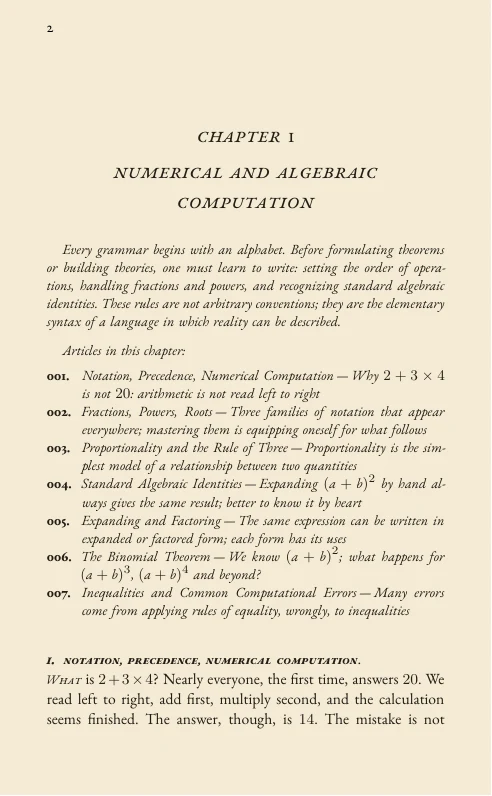
Four ideas hold the whole together. The first: calculation becomes a language. Two plus three times four is not a sequence of arbitrary gestures, but a hierarchy. And a language is for saying true things, and then proving them. An example, in thirty seconds. The square root of two is not a fraction. Suppose it is: root two equals p over q, in lowest terms. Then p squared equals two q squared. So p squared is even, and p is even. Substitute, and q squared is even, so q is too. Both even: the fraction was not in lowest terms. Contradiction. The second idea: the same object is seen twice, as a calculation and as a figure. Pythagoras’ theorem links form to number. Coordinates, then vectors, turn every figure into a calculation, and every calculation into a figure. The third: measuring change. The limit, the derivative and the integral tell how a quantity varies, and what it accumulates. The fourth: measuring chance, by counting first, then by calculating. And beneath all four runs a thread: the chain of numbers. The natural numbers, the integers, the fractions, the reals. Each time an equation refused to be solved, the numbers were enlarged. The last to hold out fits on one line: x squared plus one equals zero.
No real number will do: a square is never negative. So we decree a number, written i, whose square is minus one. The move may seem arbitrary. The book readily admits it. But let’s write each complex number as a plus b i, and place it in the plane: a on the horizontal axis, b on the vertical one. Three plus two i becomes a point. Now multiply it by i. Expand, and replace i squared with minus one: three plus two i becomes minus two plus three i. Look at the point. It has turned a quarter turn about the origin. It holds for every point: a plus b i becomes minus b plus a i. Start from one. A quarter turn: i. Another: minus one. There is i squared equals minus one: two quarter turns, a half turn. Two more, and you are back where you started. The strange rule was no quirk of calculation. It was geometry, written in algebra. In chapter thirteen, multiplying by e to the i theta turns the plane through any angle. One object, seen twice: the whole volume is in that gesture.
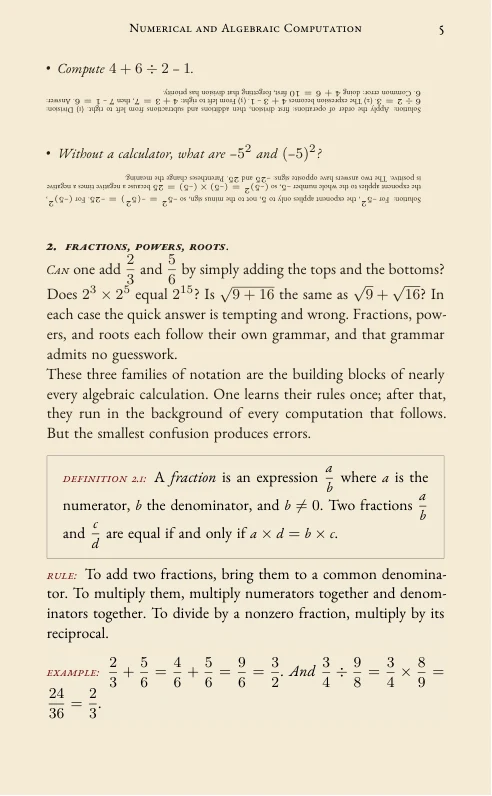
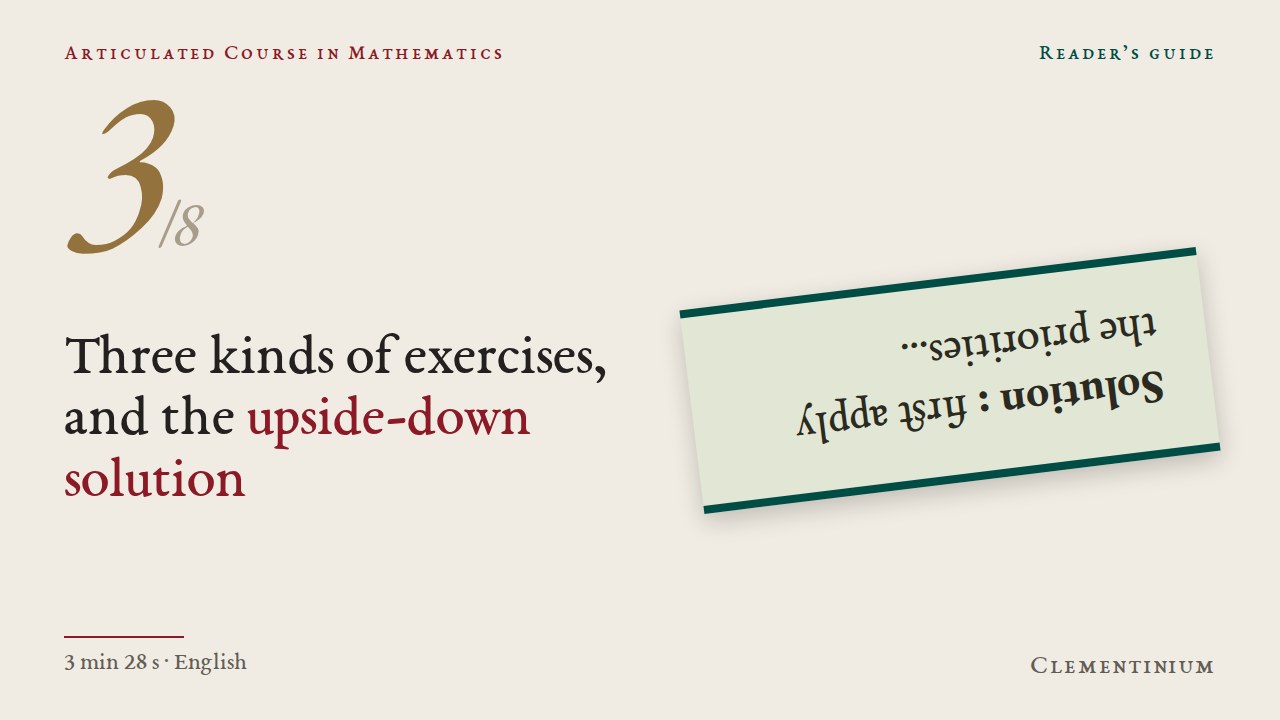
How do you work with this volume? Slowly, pencil in hand, the foreword advises. With three kinds of exercises, all with solutions, printed upside down. A practice exercise, right after the article: compute i to the power one, two, three, four, five. What pattern do you see? A cycle of length four. Four quarter turns, and round again. A study, at the end of the chapter, teaches a method: writing a rotation whose centre is not the origin. Translate, turn, translate back. About one plus i, three plus i goes to one plus three i, at the same distance from the centre. And an expedition takes you further than you’d expect: the roots of unity draw a regular triangle, pentagon and hexagon on the circle, and they add up to zero. Alongside the volume, three companions. The abridged course, to learn or relearn. The compendium, to review. The formula handbook, to check. At one article a day, the volume takes about five months.
What makes the difference comes down to a few rules. One article, one idea, from its motivation to its interpretation. The figure before the theorem. Every proof has a visible status: complete, sketched or admitted. Ten objects come back from volume to volume; the square root of two, which you just met, accompanies the whole collection. And the volume exists in French and in English. “This book is not an examination,” the foreword ends, “it is a companion for the road.”
To remember. Volume one: from secondary school to the threshold of university. Seven parts, one hundred and sixty articles, every exercise with its solution. And i: a quarter turn. Volume one opens for free: the opening pages, the table of contents and all of chapter one, exercises included. The link is in the description.
 Overview + articles 001–003 · YouTube
One idea per video
The actual book pages on screen, one idea explained and a worked exercise in each lesson. Start with the overview, then follow the articles in the order of the book.
Watch the lessons on YouTube →Work with the course
Articles, exercises, methods and companion books: films to support your reading. No account needed, in French and English.
Inside the volume
Your digital edition
The files below come together in a single purchase, in the selected language.
After payment: personal download links and access through My library.
Understand the editions →Open the book
The opening pages, table of contents, and complete first chapter. Page numbers are those of the full book. 50 p. · PDF