Learn to read mathematics
Statements, quantifiers, and proofs establish the ground rules before analysis and algebra.
Articulated Course in Mathematics · II
From Statement to Space
What makes a mathematical statement? What does convergence mean? How does a calculation reveal a structure? A course connecting analysis, algebra, geometry, and probability.
Digital PDFs. No printed book is shipped. One language per purchase.
Your starting point
The foundations of Volume I, especially algebraic manipulation and elementary proof.
The course develops the reasoning. Exercises and methods put it into practice; expeditions invite you to explore an idea further.
Statements, quantifiers, and proofs establish the ground rules before analysis and algebra.
From linear algebra to multivariable calculus, tools are developed and then encountered in new settings.
Discover this volume
Volume II: from statement to space · 7 min 31 s
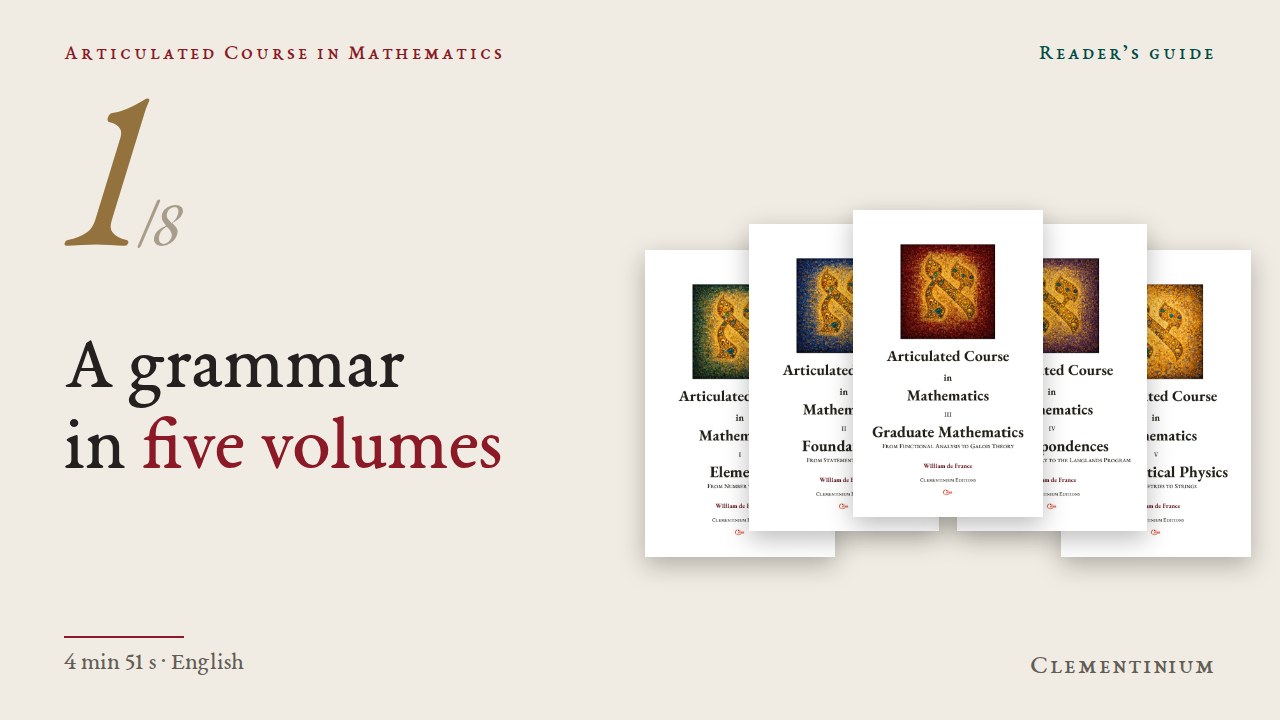
Zero, one, one, two, three, five, eight: whole numbers, every one. And yet, to write down the hundredth directly, you have to go through the golden ratio. An overview of Volume II of the Articulated Course in Mathematics: who it is for, the map (sixteen parts, sixty-two chapters, two hundred and ninety-one articles), the four ideas that hold it together, the Fibonacci sequence solved through eigenvalues, how to work with the volume, and what makes the difference.
In the book: foreword and bridge “From secondary school to university” of Volume II; articles 023, 157 and 198; exercises from chapters 4 and 42.
Read the free excerpt ↓Zero, one, one, two, three, five, eight, thirteen. Each number is the sum of the two before it. Whole numbers, every one. And yet, to write down the hundredth one directly, you have to go through a number that is not whole, not even a fraction: the golden ratio. Articulated Course in Mathematics. Volume two: from statement to space.
The second volume asks three questions. What makes a mathematical statement? What does convergence mean? How does a calculation reveal a structure? It is for anyone studying undergraduate mathematics. It assumes volume one, above all algebraic manipulation and elementary proof. And from its first page it announces a change. In secondary school, a theorem was a tool: you applied it, then moved on to the next exercise. Here, a theorem becomes an object: you prove it, you look for its limits. So the volume leads to the threshold of graduate mathematics, where volume three begins.
Here is the map. Sixteen parts. Sixty-two chapters. Two hundred and ninety-one articles, over fifteen hundred pages. A first part to learn how to read. Then analysis, the main thread, in eight parts: sequences, limits, derivatives, integrals, series, differential equations. Algebra, in five: vectors, matrices, numbers, polynomials, groups. Euclidean geometry. And, to finish, combinatorics and probability.
Four ideas hold the whole together. The first: read a statement before proving it. For every x, there is a y greater than x: true. There is a y greater than every x: false. The same words, in another order. The second: the limit. A convergent sequence, a continuous function, a derivative, a series: each time the same idea, written with the same quantifiers. The third: structure. The group isolates, in three axioms, what the addition of integers, the composition of permutations and the product of matrices have in common. The vector space brings vectors in the plane, polynomials and continuous functions under one roof. The fourth: approximating what cannot be computed exactly. Longer and longer polynomials hug the cosine closer and closer, and each coefficient is read off a derivative. And beneath all four runs a thread: the same principles return in other forms. Symmetry, approximation, linearisation, the passage from local to global. The division of integers sheds light on the division of polynomials.
Back to the Fibonacci sequence. Put two consecutive terms in a vector. Moving to the next term means multiplying by a matrix: one, one, one, zero. So the hundredth term needs that matrix to the power one hundred. A hundred matrix products: that takes a while. But if the matrix were diagonal, it would be immediate: you would just raise each entry to the power one hundred. Diagonalising means changing basis to get back to that case. Let’s find the eigenvalues. They are the roots of lambda squared minus lambda minus one. The first is one plus root five, over two: one point six one eight, the golden ratio. The other is minus nought point six one eight. Out comes a closed formula: the golden ratio to the power n, minus the other value to the power n, all divided by root five. Irrational numbers going in, and whole numbers coming out, every time. Better still: the second term soon becomes tiny. The golden ratio to the power twelve, divided by root five, gives one hundred and forty-four point nought nought one. The twelfth term is one hundred and forty-four. The eigenvalues did the calculation for us.
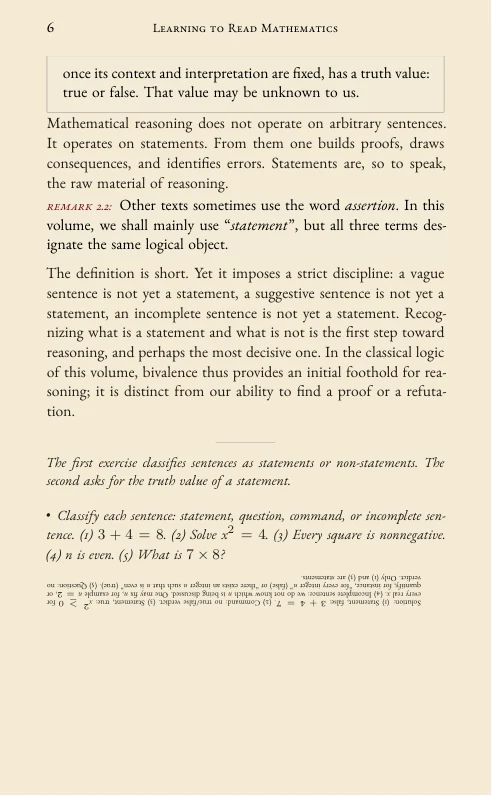
How do you work with this volume? With the same three kinds of exercises as volume one, all with solutions, printed upside down. A practice exercise, in chapter four: write the convergence of a sequence with its quantifiers. For every epsilon, there is a rank N. That sentence carries the whole of analysis. A study, in chapter forty-two, applies the same method to another recurrence. Write the matrix, find the spectrum, write the formula. The eigenvalues are two and three, and the general term is written with two to the n and three to the n. And an expedition leads to stochastic matrices: the Perron–Frobenius theorem. Take a system with two states: each day it stays where it is or switches, with fixed probabilities. In the long run, the split settles: four sevenths, three sevenths. It is the same idea that ranks the pages of the Web. Alongside the volume, the three companions. The abridged course, to learn or relearn. The compendium, to review. The formula handbook, to check. At one article a day, the volume takes about ten months.
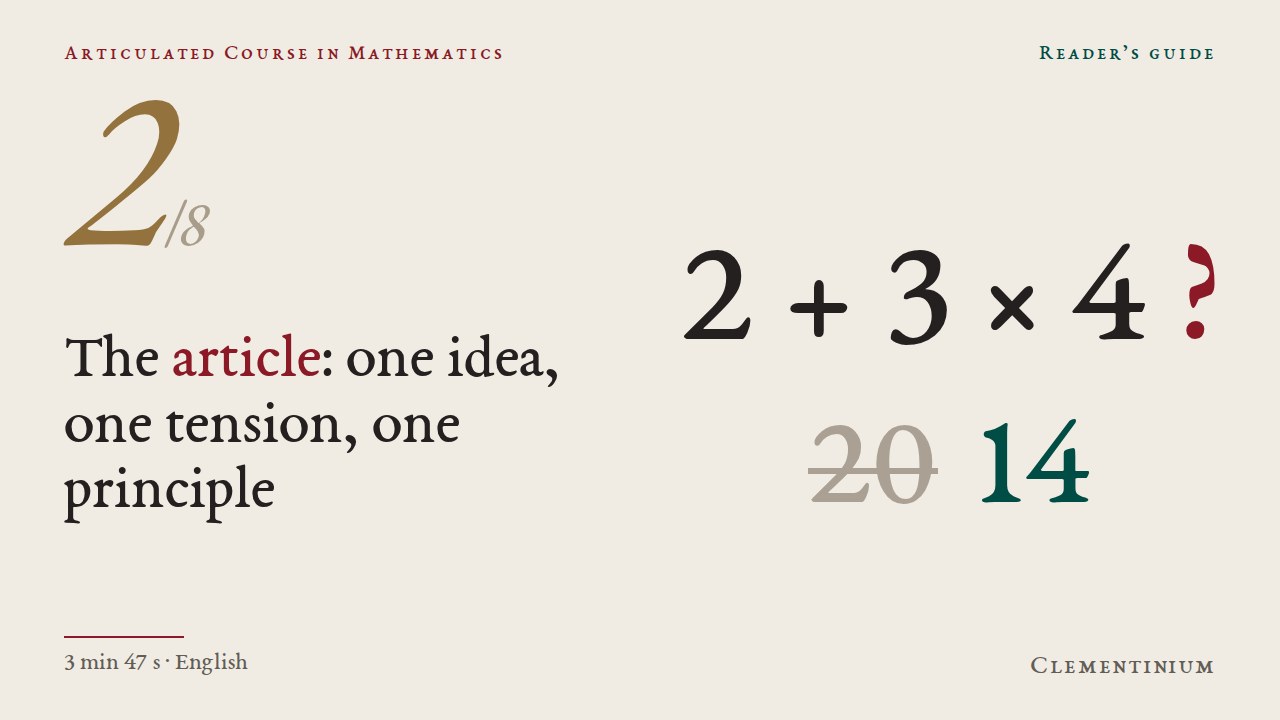
What makes the difference comes down to a few rules. One article, one idea: it opens on a tension, never on a dry definition. Each term keeps exactly the same meaning wherever it appears. Every proof has a visible status: complete, sketched or admitted. And the volume exists in French and in English. “It is by understanding why a result is true that one ceases to need to memorize it.”
To remember. Volume two: the foundations of university mathematics. Sixteen parts, two hundred and ninety-one articles, every exercise with its solution. And eigenvalues that do the calculating for us. Volume two opens for free: the opening pages, the table of contents and all of chapter one. The link is in the description.
Work with the course
Articles, exercises, methods and companion books: films to support your reading. No account needed, in French and English.
Inside the volume
Your digital edition
The files below come together in a single purchase, in the selected language.
After payment: personal download links and access through My library.
Understand the editions →Open the book
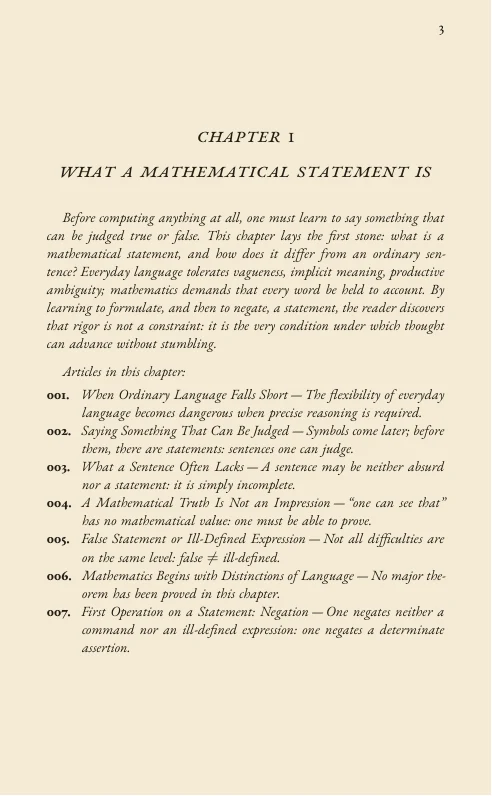
The opening pages, table of contents, and complete first chapter. Page numbers are those of the full book. 46 p. · PDF