Change the setting
Topology, function spaces, and measure extend the ideas of distance, limit, and integral.
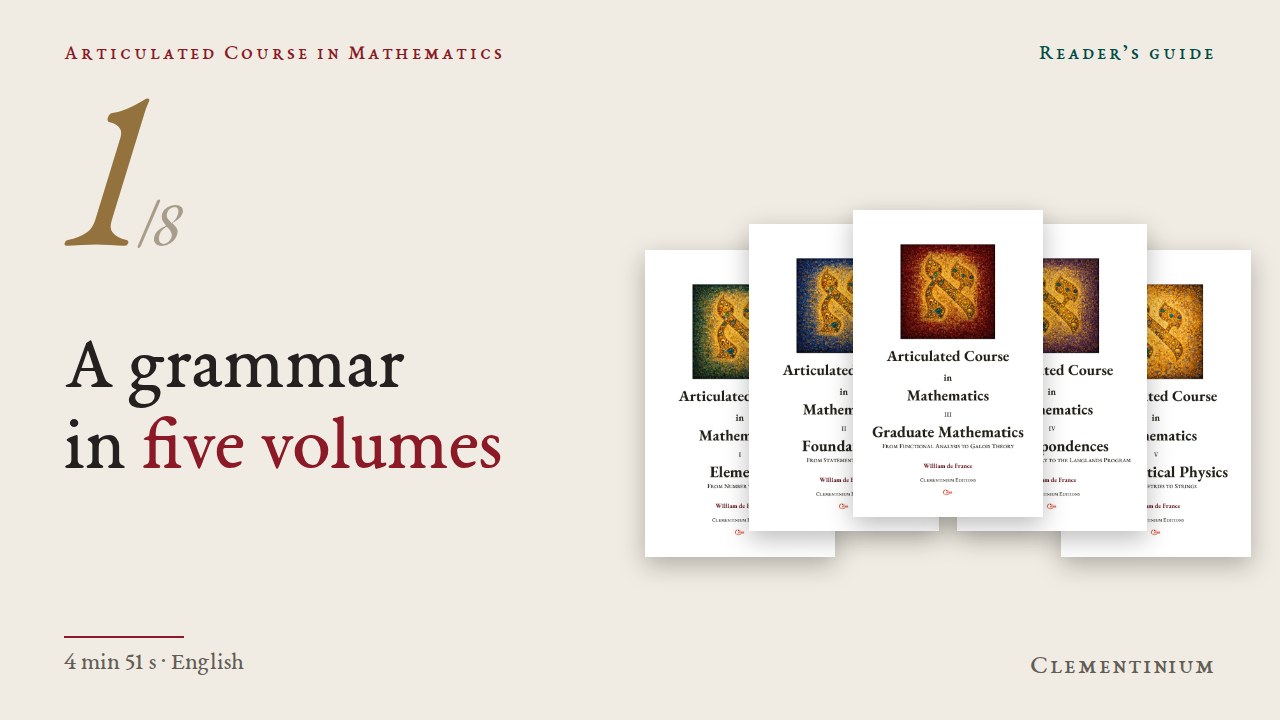
Articulated Course in Mathematics · III
From Functional Analysis to Galois Theory
Move from tools to theories. Functional spaces, measure, geometry, and algebra meet in a volume that develops the ability to change perspective without sacrificing precision.
Digital PDFs. No printed book is shipped. One language per purchase.
Your starting point
A working knowledge of the analysis and algebra developed in Volume II.
The course develops the reasoning. Exercises and methods put it into practice; expeditions invite you to explore an idea further.
Topology, function spaces, and measure extend the ideas of distance, limit, and integral.
Analysis, probability, geometry, and algebra form a connected course of 86 chapters.
Discover this volume
Volume III: from functional analysis to Galois theory · 7 min 23 s
x⁵ − 4x + 2 = 0 has five solutions, and a computer gives them in an instant. And yet no formula will ever write them with radicals: not because nobody has found it, but because it cannot exist. An overview of Volume III of the Articulated Course in Mathematics: who it is for, the map (twenty-five parts, eighty-six chapters, four hundred and fifty-five articles), the four ideas that hold it together, Galois theory at work on one equation, how to work with the volume, and what makes the difference.
In the book: foreword and bridge “From undergraduate to graduate” of Volume III; articles 046, 072, 216 and 217; exercises from chapter 52.
Read the free excerpt ↓Here is an equation of degree five. x to the fifth, minus four x, plus two, equals zero. It has five solutions, and a computer gives them in an instant. And yet no formula will ever write them with square roots, cube roots or fifth roots. Not because nobody has found it yet. Because it cannot exist. Articulated Course in Mathematics. Volume three: from functional analysis to Galois theory.
The third volume makes a promise: to move from tools to theories, and to change perspective without losing precision. It is for anyone taking on master’s-level mathematics. It assumes a working command of the analysis and algebra of volume two. And it names the real change. At the undergraduate level, the path was marked: definition, theorem, proof, exercise. At the graduate level, you must often find the path yourself. That change is not about theorems: it is about the way of seeing. Volumes four and five both start from here.
Here is the map. Twenty-five parts. Eighty-six chapters. Four hundred and fifty-five articles, some two thousand six hundred pages. Analysis first: function spaces, measure, Fourier, holomorphic functions. Chance: probability, processes, statistics. Equations: differential, partial differential, dynamical systems. Algebra and geometry: groups, fields, Galois, manifolds, algebraic geometry. And computation: numerical analysis and simulation.
Four ideas hold the whole together. The first: changing space. Finite dimension is no longer enough, and functions become points. Stir a cup of coffee: at least one point of the liquid comes back to where it was. That is a fixed-point theorem, Brouwer’s. The second: giving a meaning to what had none. The Lebesgue integral, and distributions, which differentiate functions that have no derivative. The path of Brownian motion is continuous everywhere and differentiable nowhere: however far you zoom in, it never straightens out. The third: seeing hidden symmetries. Galois theory reads in an equation the group of its symmetries. The fourth: curved spaces. Manifolds replace the plane and space with curved spaces that can only be observed locally, chart by chart. And beneath all four runs a thread. The same gesture, the quotient, creates the integers modulo n in arithmetic, the quotient topology in geometry, and the L p spaces in analysis. At this level, the great themes of the collection are no longer intuitions: they are tools of proof.
Back to our equation. For degrees two, three and four, formulas exist: Cardano’s and Ferrari’s. For degree five, Abel shows in eighteen twenty-four that the general equation holds out. Galois says why, and for each equation. Let’s draw the curve. It crosses the axis three times: three real roots. The other two are complex, and conjugate. The Galois group gathers the permutations of the roots that algebra cannot tell apart. Conjugation swaps the two complex roots and fixes the other three: a transposition. The polynomial is irreducible, so the group also contains a cycle of length five. A transposition and such a cycle are enough: you get all one hundred and twenty permutations. The group is S five, all of it. But a formula in radicals would require a solvable group, one that can be taken apart in abelian layers. S five is not. So the formula is impossible, for this very equation. The roots exist: we can compute them to any precision. They only escape every formula. As the book puts it, the limit is not in the numbers, but in the language.
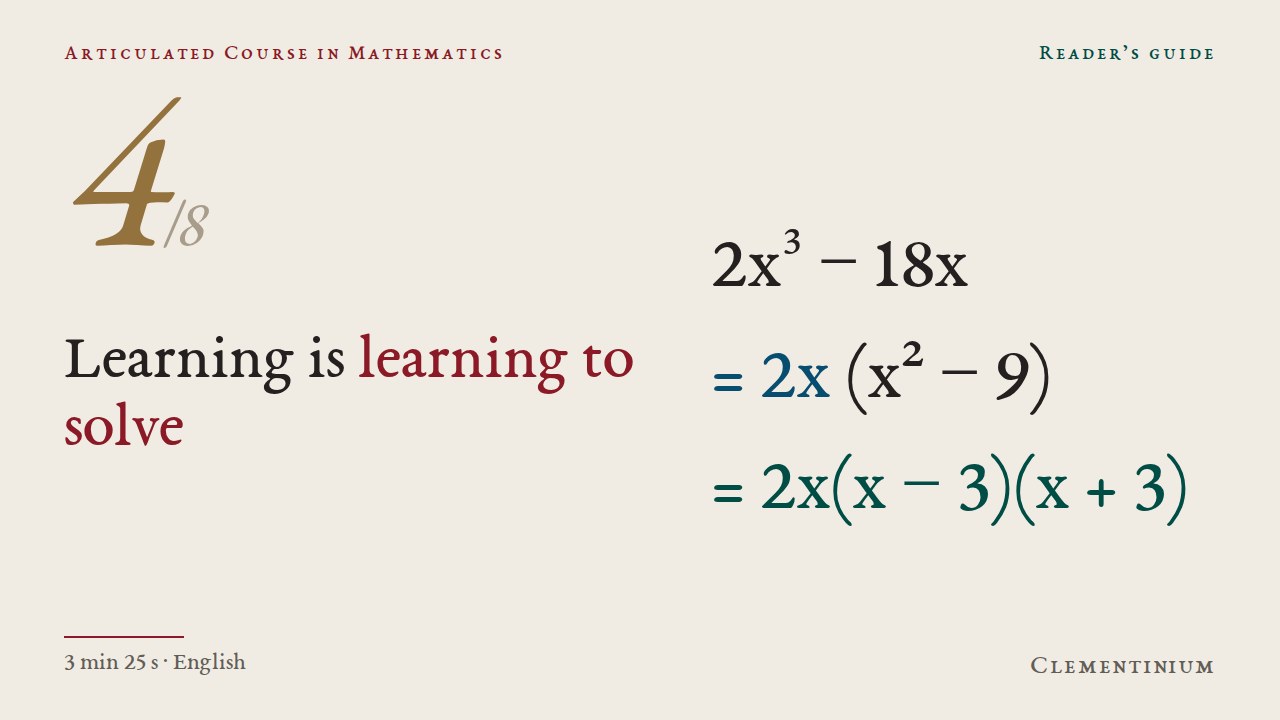
How do you work with this volume? With the same three kinds of exercises, all with solutions. And with two parts written for the reader: reading and working through a master’s course, then three chapters of transition exercises. A practice exercise, in chapter fifty-two: prove that an angle of sixty degrees cannot be trisected with ruler and compass. The cosine of twenty degrees has degree three, and three is not a power of two. A study teaches the criterion that settles the problems of antiquity: a constructible number has degree a power of two. And an expedition retraces the path of Gauss, who showed at eighteen that the regular seventeen-sided polygon can be constructed. Alongside the volume, the three companions. The abridged course, to learn or relearn. The compendium, to review. The formula handbook, to check. At one article a day, the volume takes about fifteen months.
What makes the difference comes down to a few rules. One article, one idea. Echoes from one field to another, pointed out: you move from knowing the pieces to seeing the building. Every proof has a visible status: complete, sketched or admitted. And the volume exists in French and in English. “Reading an article, following a seminar, identifying the right question: these skills, harder to teach than theorems, are what make a mathematician.”
To remember. Volume three: master’s-level mathematics. Twenty-five parts, four hundred and fifty-five articles, every exercise with its solution. And an equation whose roots exist, but escape every formula. Volume three opens for free: the opening pages, the table of contents and all of chapter one. The link is in the description.
Work with the course
Articles, exercises, methods and companion books: films to support your reading. No account needed, in French and English.
Inside the volume
Your digital edition
The files below come together in a single purchase, in the selected language.
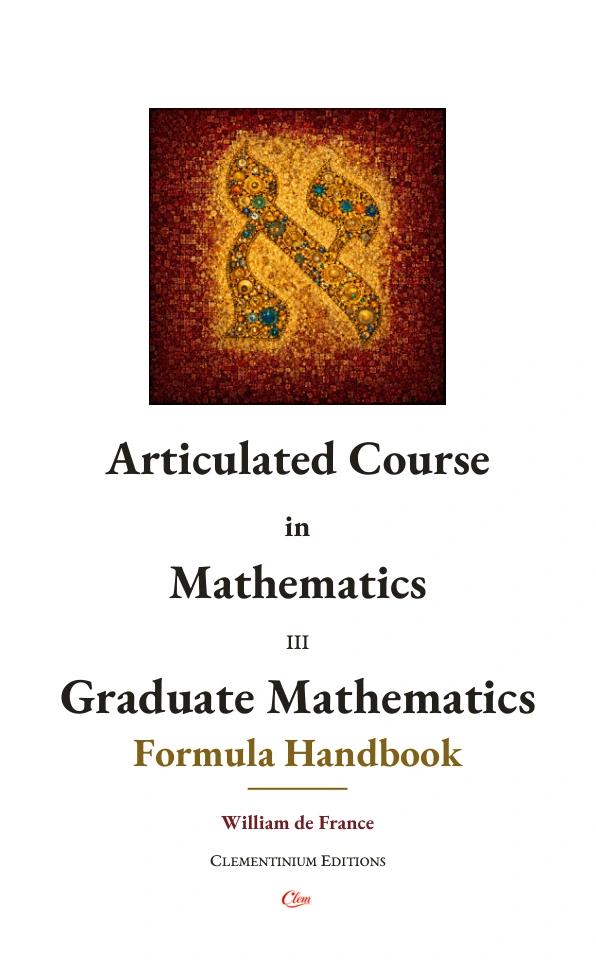
After payment: personal download links and access through My library.
Understand the editions →Open the book
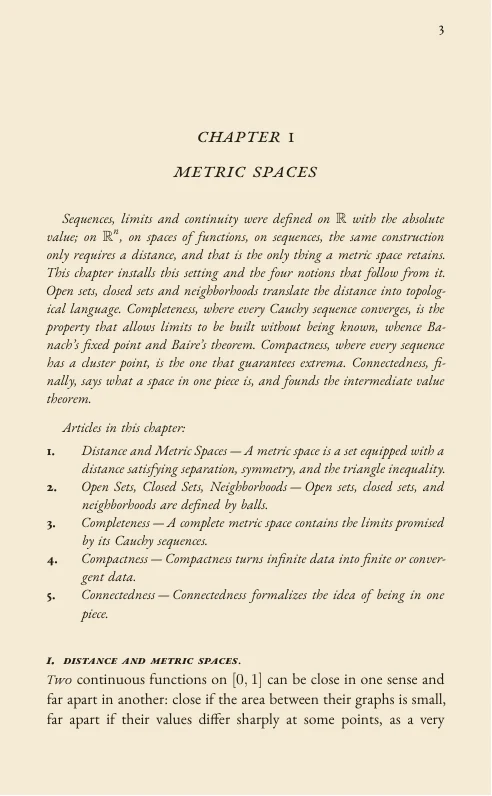
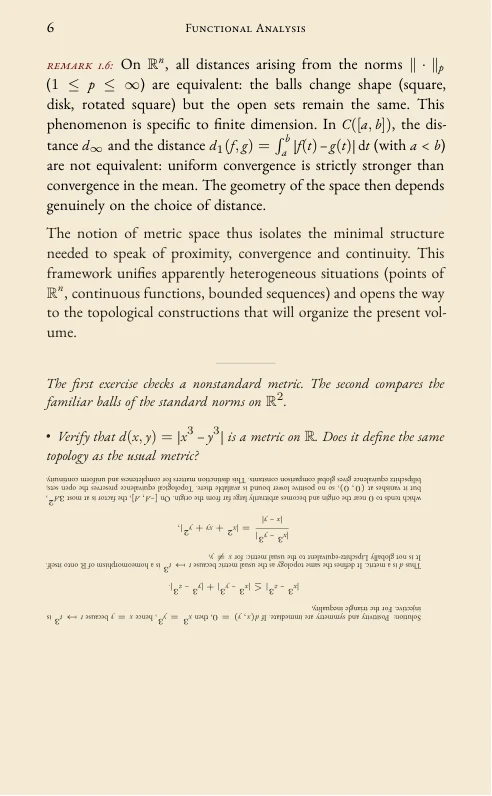
The opening pages, table of contents, and complete first chapter. Page numbers are those of the full book. 64 p. · PDF