From symmetries to field theories
Mechanics, relativity, quantum states, and gauge theories form the volume’s first thread.
Articulated Course in Mathematics · V
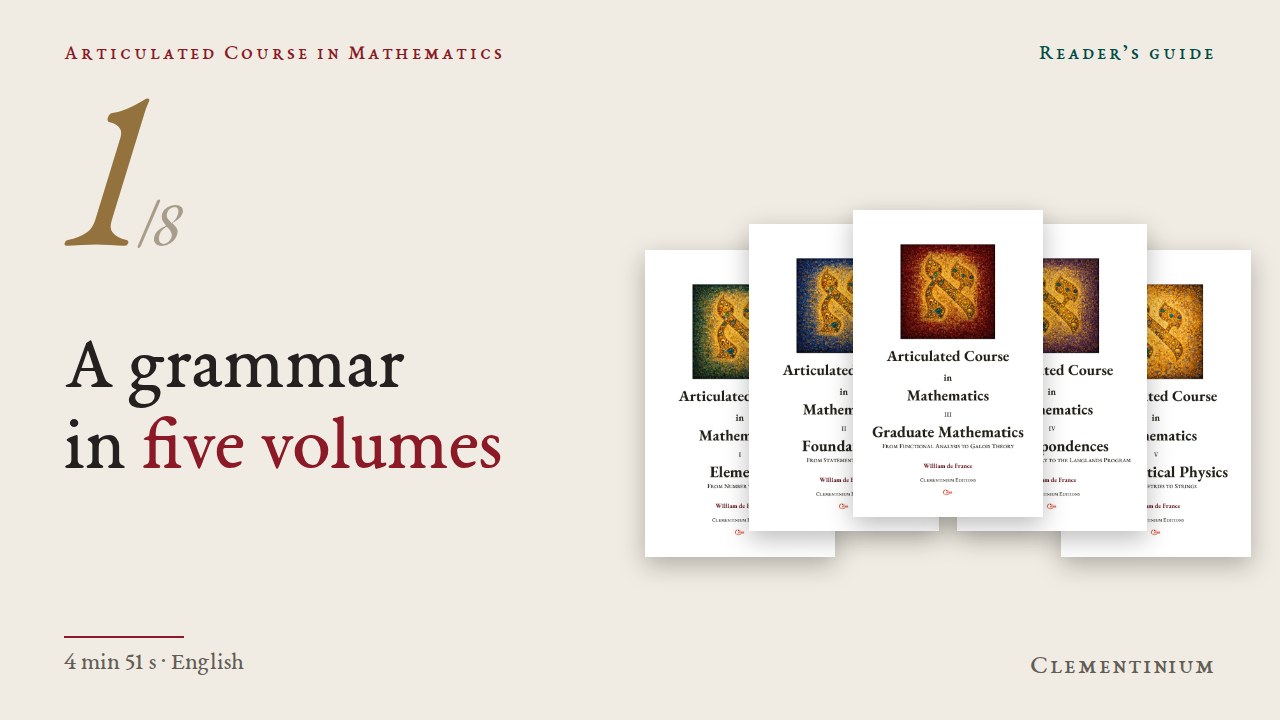
From Symmetries to Strings
From mechanics to quantum fields and strings: understand what symmetries require, what geometry reveals, and what physical models actually allow us to conclude.
Digital PDFs. No printed book is shipped. One language per purchase.
Your starting point
Advanced analysis and geometry. Volume IV illuminates some correspondences but is not required for every chapter.
The text distinguishes established results, constructions under stated assumptions, and research perspectives. Reminders and cross-references support the reading.
Mechanics, relativity, quantum states, and gauge theories form the volume’s first thread.
String constructions, holography, and effective theories lead to physical regimes, then to empirical questions and the limits of the models.
Discover this volume
Volume V: from symmetries to strings · 8 min 28 s
An isolated magnetic source, a sphere around it: a single matching condition forces every electric charge to be a whole multiple of one unit. This does not prove that monopoles exist; it shows how a mathematical structure imposes a condition on physics. An overview of Volume V of the Articulated Course in Mathematics: who it is for, the map (eight parts, forty-four chapters, four hundred and six articles), the four ideas that hold it together, the Dirac monopole worked out with two charts on a sphere, how to work with the volume, and what makes the difference.
In the book: foreword and bridge “From Correspondences to Physical Regimes” of Volume V; articles 003 and 089; end of chapter 14.
Read the free excerpt ↓Imagine an isolated magnetic source: a monopole. Surround it with a sphere. A single matching condition on that sphere then forces every electric charge to be a whole multiple of one unit. This does not prove that monopoles exist. It shows how a mathematical structure imposes a condition on physics. This volume is about how, and how far. Articulated Course in Mathematics. Volume five: from symmetries to strings.
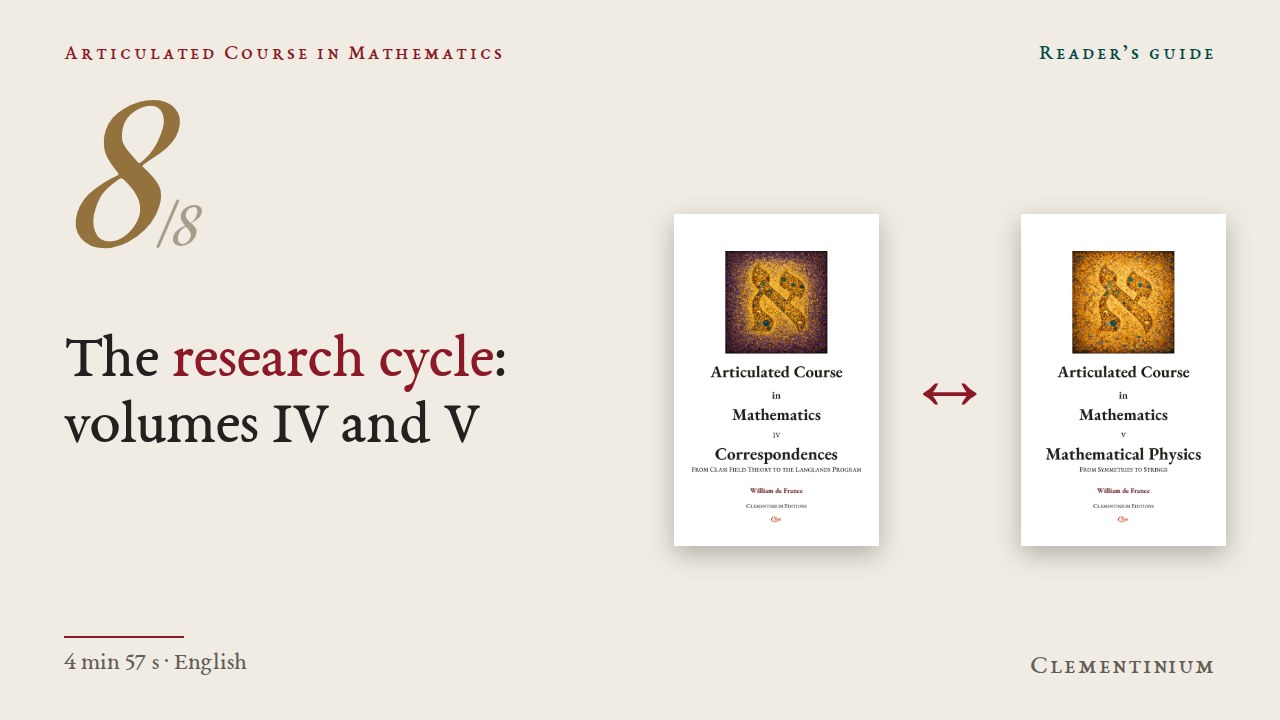
The fifth volume makes a promise. It studies how mathematical structures become physical descriptions. It brings one requirement: to say, at every step, what the structure imposes and what it leaves undetermined. It is for readers who want to connect advanced mathematics with physical theories. It assumes the tools of volume three: analysis, algebra and geometry. Volume four illuminates some chapters, without being required. And it names the real change. Physics adds to the structures states, an evolution and observables. Two descriptions are no longer compared only through their spaces, but through what they allow us to calculate in the same regime. Together with volume four, it opens the research level.
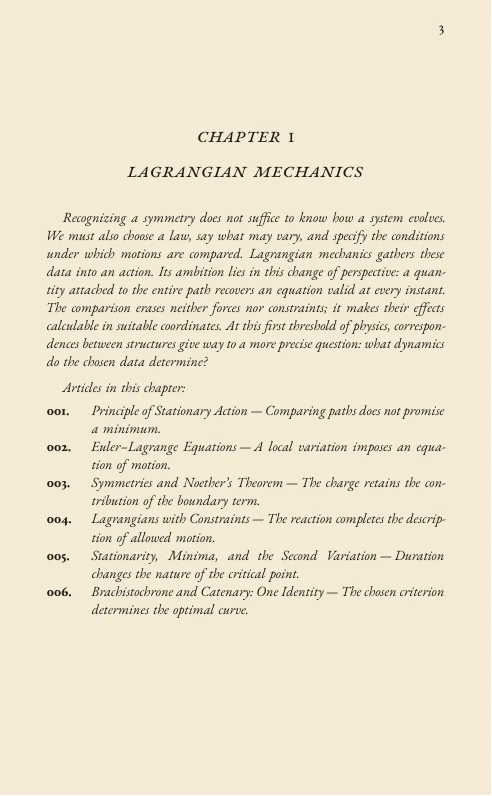
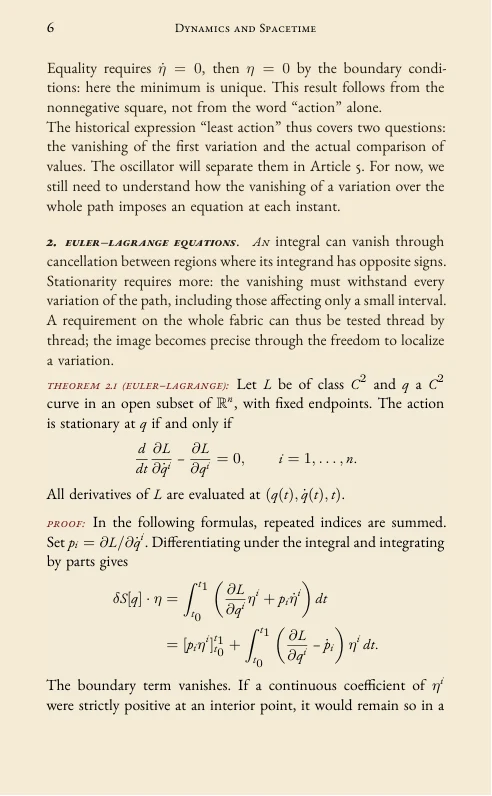
Here is the map. Eight parts. Forty-four chapters. Four hundred and six articles, one thousand and seventy-two pages. Mechanics and symmetries first: Lagrange, Hamilton, Lie groups, relativity and gravitation. Then quantum states: operators, information, collective systems. Then fields: bundles, connections, quantization, renormalization and the Standard Model. Exact structures: conformal symmetry, supersymmetry, integrability, gauge dualities. Strings, built step by step, then holography and quantum black holes. Finally, calculated limits recover physical regimes, confronted with observation.
Four ideas hold the whole together. The first: symmetry imposes laws. Noether’s theorem attaches a conserved quantity to each symmetry, and Lie groups, with their representations, give the language of transformations. The second: quantum states, and what can be observed. A Hilbert space is not enough to define an experiment: it takes operator domains, states and rules of measurement. Information and collective systems put these choices to the test. The third: fields as geometry. Bundles carry fields, connections their transport, curvature their local interactions. Then come quantization, changes of scale and the Standard Model. The fourth: building strings and holography step by step. The worldsheet gives the starting point: its action, constraints and quantization determine a spectrum. Volume four leads to geometric Langlands; here its physical reading returns through gauge dualities and branes, without being confused with the proof. And beneath all four runs a thread: the book says what a model establishes, and what it does not. A symmetry does not choose a dynamics by itself. An action yields equations; it does not yet determine their quantization. An effective theory does not describe every scale.
Back to the monopole. Its magnetic field crosses the sphere: the flux is not zero. But if that field came from a potential defined everywhere, the flux would be zero, by Stokes. So we need two charts: one for the northern hemisphere, one for the southern. In the north, one potential, regular near the north pole. In the south, another, regular near the south pole. Both give the same field. Their difference, along the equator, is n times d phi. Passing from one chart to the other multiplies the phase of the charged particle by a complex number of modulus one: the circle of volume one, now a gauge group. But the equator is a circle: after one turn, the phase must come back to itself. It does so exactly when n is a whole number. By Stokes on the two hemispheres, the total flux is two pi times n. In physical units, for a charge q and a flux four pi g, the condition reads: two q g over h bar equals n, a whole number. Every charge coupled to this monopole is therefore a whole multiple of the same unit. This calculation does not prove that the monopole exists, and does not fix the value of a fundamental charge. It shows this: the topology of the sphere constrains a physical quantity, without supplying its equation of motion. To compare fibers along paths, and to see what still depends on a choice, we need the notion of connection. That is the next chapter.
How do you work with this volume? The article remains the unit of reading: one idea, developed through a calculation whose assumptions and scope remain visible. As in volume four, each chapter closes with further reading, then with a research question: it tests a construction, or distinguishes two operations. It does not claim to solve a general open problem. Chapter fourteen, on bundles, closes on this question: can two obstructions disappear when the fibers are joined? The book constructs the answer: a line bundle and its opposite, neither of them trivial, have a trivial sum, declaring as admitted the gluing theorem it uses. At one article a day, the volume takes about thirteen months.
What makes the difference comes down to a few rules. One article, one idea. Proofs are given, sketched or admitted, and the reader can see which case applies. A conjecture is distinguished from proved results. And the volume exists in French and in English. “The reader will meet groups, bundles, cohomology, and categories again. The question now is which physical data they organize and what they leave undetermined.”
What to remember. Volume five: from symmetries to strings. Eight parts, four hundred and six articles, from mechanics to dualities, strings and holography. And one sphere, two charts, a phase to match: geometry imposes a condition on physics. Volume five opens for free: the first pages, the table of contents, and the whole of chapter one. The link is in the description.
Work with the course
Articles, exercises, methods and companion books: films to support your reading. No account needed, in French and English.
Inside the volume
Your digital edition
The files below come together in a single purchase, in the selected language.
After payment: personal download links and access through My library.
Understand the editions →Open the book
The opening pages, table of contents, and complete first chapter. Page numbers are those of the full book. 38 p. · PDF